
Warehouse Floor Coatings for GTA Logistics and Storage Facilities
Buildwell restores and coats warehouse slabs across Toronto and the Greater Toronto Area — controlling dust, protecting concrete from forklift wear, and marking safe traffic routes, all scheduled around your operation rather than in place of it.
- Dust-free, easily scrubbed surfaces
- Forklift and pallet-jack rated build-ups
- Colour-coded aisle and pedestrian striping
- Slab restoration instead of costly replacement
- Phased, zone-by-zone install around live operations
- Light-reflective finishes that brighten the facility
What warehouse floor coatings do for a working facility
A warehouse floor has one job: carry traffic and inventory reliably without generating problems elsewhere in the operation. Bare concrete quietly fails at this. It sheds dust onto stock and into equipment, absorbs oil and hydraulic fluid, and erodes at joint edges until every pallet jack pass sounds like a collision.
A coating changes the economics. Dust generation stops, spills stay on the surface where they can be wiped up, the slab is protected from further abrasion, and the floor becomes bright enough that many facilities notice the lighting improvement before they notice anything else. For facility managers, the measurable outcomes are lower cleaning labour, fewer inventory damage claims and a slab that is still serviceable in a decade.
The systems we install range from a straightforward densify-and-seal for large dry-storage areas up to full epoxy and polyaspartic builds in dock zones, battery rooms and pick faces. The right answer is nearly always a mix, not a single product across the whole building.
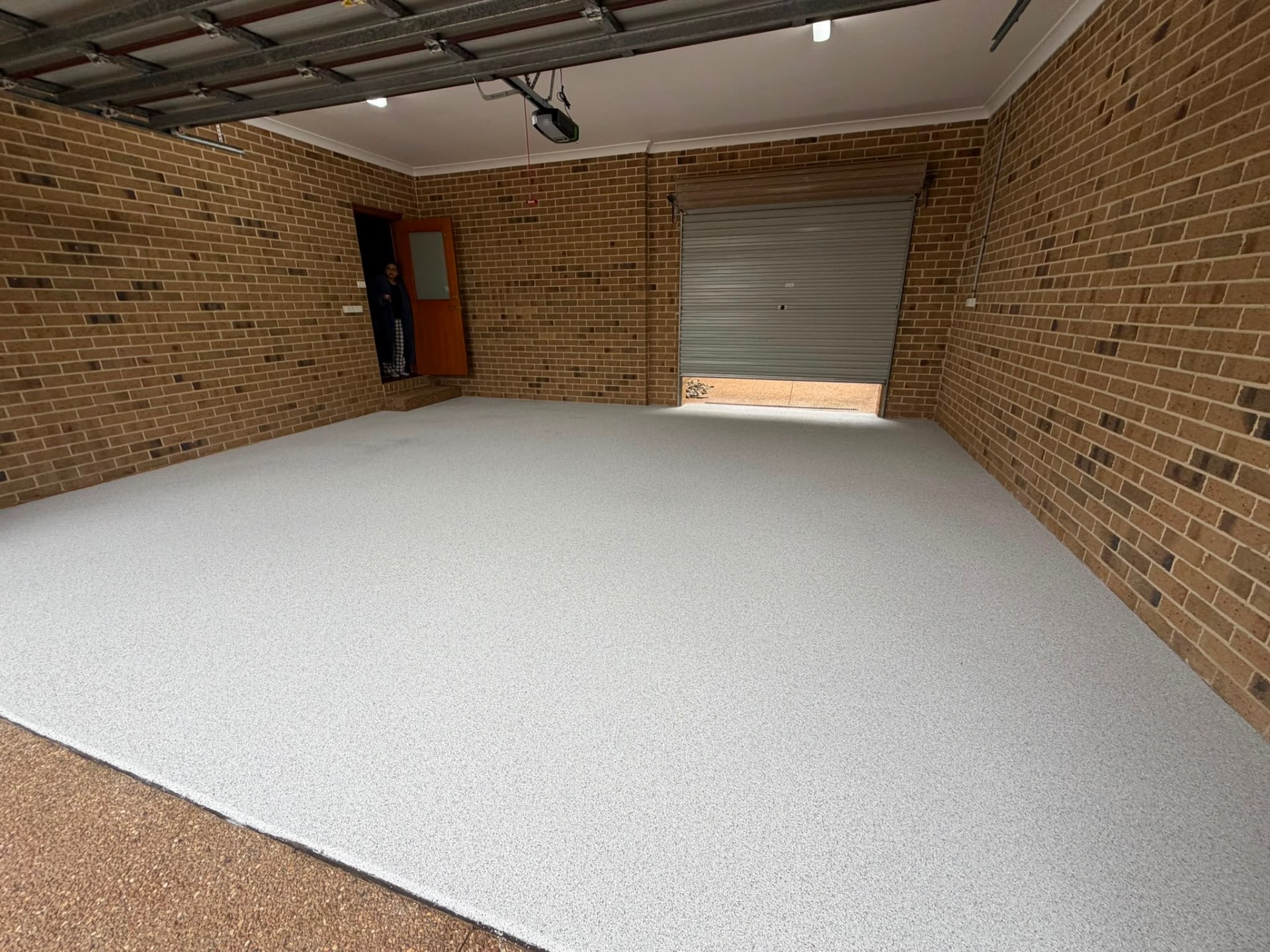
Coating options for warehouses, compared honestly
Four systems cover almost every warehouse requirement in the GTA. Each has a clear place, and each has a limitation worth knowing before you sign.
Densify and seal
Lithium silicate densifier plus a penetrating sealer. Lowest cost per square foot, keeps the concrete look, stops dusting, and cannot peel because there is no film. Limited stain and chemical resistance, and it will not hide existing discolouration.
Roll-applied epoxy coating
100% solids epoxy at 12–20 mils in a solid colour. Excellent value for mid-traffic areas, easy to clean, holds line striping crisply. Rigid, so slab movement must be managed at joints, and it ambers under strong UV unless topcoated.
Polyaspartic and hybrid systems
Fast-cure topcoats that return a zone to service in hours rather than days, with excellent abrasion and UV resistance. Higher material cost and a short working window, so they demand an experienced crew — but often the only option for a facility that cannot stop.
Urethane cement
The heaviest option, used where thermal shock, wash-down or food-grade chemistry are present. Extremely tough and moisture-tolerant. Textured rather than glossy, and priced accordingly, so we reserve it for the zones that genuinely need it.
High-traffic zones and where warehouse floors actually wear
Wear in a distribution centre is not evenly distributed. Well over half of the damage we see concentrates in a small percentage of the floor area: dock plate approaches, the first ten metres inside overhead doors where road salt and grit come in, turning circles at aisle ends, and the pick faces where equipment stops and starts hundreds of times a shift.
Designing to that reality lets us put a heavier, mortar-based build in those zones and a lighter, cheaper system in the racking bays where nothing but a pallet ever touches the floor. Facilities that coat everything to the same spec either overspend on the quiet 70% or underspec the busy 30% and are back within three years.
Joint condition deserves the same attention. Spalled control joints are the number-one cause of forklift damage and driver complaints. Filling them with a semi-rigid polyurea supports the joint edge so wheels roll across rather than drop into them — a repair that pays for itself in equipment maintenance alone.
- Reinforced dock plate and overhead door transitions
- Semi-rigid polyurea control joint filling
- Heavier build in turning circles and pick faces
- Economical densified seal under static racking
Restoring an existing warehouse floor
Most of our warehouse work is restoration rather than new construction. A twenty-year-old GTA slab typically arrives with a failed original coating, pitting from freeze-thaw at the doors, oil saturation under equipment, and joints that have broken down under a decade of forklift traffic.
The sequence is consistent. We remove the failed coating and contaminated surface by shot blasting or diamond grinding, treat oil-saturated areas, rebuild spalls and pits with a fast-set repair mortar, chase and fill cracks, and refill control joints. Only then is the slab re-profiled and primed. The finished floor is flat, sound and coated to a documented specification.
Where a slab has active structural movement or severe settlement, coating is the wrong answer and we will say so. Restoration works because the concrete underneath is fundamentally sound — our assessment tells you honestly whether yours is.
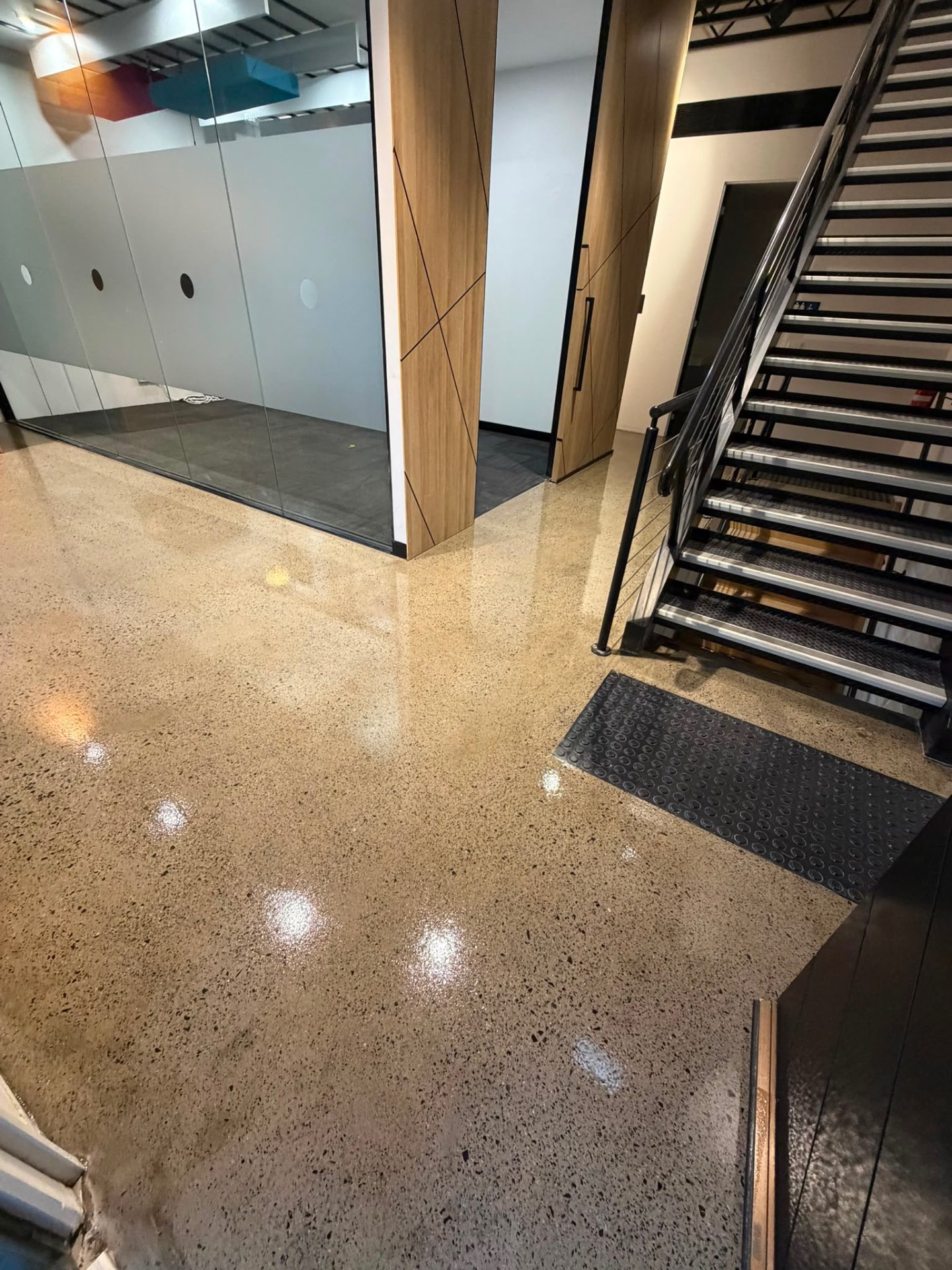
Safety marking, wayfinding and compliance
Once the floor is coated, line striping becomes permanent infrastructure rather than tape that lifts within a month. We apply pigmented epoxy or polyaspartic striping under the final clear coat so the markings sit inside the system and cannot be scrubbed or driven off.
Typical layouts separate forklift aisles from pedestrian walkways, define staging and outbound zones, mark hazard areas around battery charging and compressor rooms, and keep electrical panels and fire equipment clear. Colour conventions are agreed with your health and safety lead so the finished floor supports your existing procedures rather than replacing them.
Slip resistance is specified at the same time. We adjust the broadcast aggregate to the environment — a light profile for dry storage where mopping matters, a heavier one at door thresholds and wash-down areas where water and slush arrive daily.
Maintaining a coated warehouse floor
Coated floors are dramatically easier to maintain than bare concrete, but they are not maintenance-free. Auto-scrub on a regular cycle with a neutral-pH cleaner; high-alkaline or citrus degreasers will progressively dull a topcoat. Keep grit off the floor at door thresholds with entry matting, because tracked-in sand is effectively sandpaper under forklift wheels.
Inspect the wear lanes annually. When the topcoat begins to thin — usually visible as a change in sheen before any substrate shows — a scuff-sand and recoat of that zone restores the system for a small fraction of the original cost. Left until the substrate is exposed, the repair becomes a rebuild.
We hand over a written system record at completion, listing every product, thickness and recommended cleaning chemistry, and our workmanship is backed by a 10-year warranty where the maintenance schedule is followed.
Warehouse floor coatings at a glance
- Best suited to
- Distribution centres, 3PL and logistics facilities, storage and fulfilment warehouses
- Primary benefits
- Dust elimination, slab protection, safety marking, brighter facility, easier cleaning
- System options
- Densify and seal, roll-applied epoxy, polyaspartic hybrid, urethane cement
- Return to service
- 12–24 hours with fast-cure systems; 48–72 hours with standard epoxy
- Typical service life
- 8–15 years with periodic topcoat renewal in wear lanes
- Scheduling
- Phased zones, night shifts and weekends around live operations
- Service area
- Toronto, Mississauga, Brampton, Vaughan, Markham, Scarborough and the wider GTA
Warehouse Floor Coating FAQs — Toronto & GTA
Explore related flooring systems and service areas
Warehouse Flooring Solutions
Industry guide for distribution and logistics decision-makers.
Industrial Epoxy Flooring
Heavy-duty systems for manufacturing and processing environments.
Commercial Epoxy Flooring
Our core commercial epoxy service across the GTA.
Concrete Grinding & Sealing
The lower-cost dust-control route for large dry-storage areas.
Solid Colour Epoxy Flooring
Clean, brightly pigmented finishes that hold line striping crisply.
Office & Retail Epoxy Flooring
For the front-of-house areas attached to your warehouse.
Epoxy Flooring in Brampton
Serving the Bramalea and Highway 407 logistics corridor.
Book a free warehouse floor assessment
Tell us your square footage, equipment type and operating hours. We will walk the slab, map the wear zones and return a phased proposal that keeps your building running.
Call: (647) 970-8226
Email: Buildwellflooringsolutions@gmail.com
Shop: 7030 Woodbine Ave, Markham, ON L3R 6G2
Free estimates · 10-year workmanship warranty · Fully insured
Prefer email? Use our contact page.
Serving Toronto & the GTA · Free estimates · 10-year workmanship warranty
Get a Free Estimate