
Manufacturing Facility Flooring for Plants Across the GTA
Buildwell specifies and installs resin floors for manufacturing plants, processing facilities and production lines throughout the Greater Toronto Area — engineered for machinery loads, chemical exposure and wash-down, and installed around your production schedule rather than through it.
- Mortar-based builds for machinery and impact zones
- Chemical resistance matched to your actual process
- Urethane cement for thermal shock and wash-down
- Slip resistance specified per production area
- Zone-by-zone installs around live production
- Written system record and 10-year workmanship warranty
What plant managers are actually buying
A manufacturing floor is a process surface. It sits underneath your machinery, your material handling and your people, and the plants that treat it as a consumable rather than an asset end up paying for it twice — once in patch repairs and again in the downtime those repairs cost.
Plant managers rarely open a conversation about flooring. They open it about a coolant spill that has soaked into the slab and cannot be cleaned to audit standard, about a coating that is delaminating in the forklift lane, about a wash-down bay where water sits in low spots, or about an insurer asking why pedestrian routes are unmarked. All of those are flooring outcomes.
So the specification starts with the process, not the product. What chemicals reach the floor, at what concentration and what temperature. What equipment sits on it and how it is anchored. What gets dropped. How the area is cleaned and how often. How many hours a week the zone is genuinely available. Every meaningful decision follows from those answers.
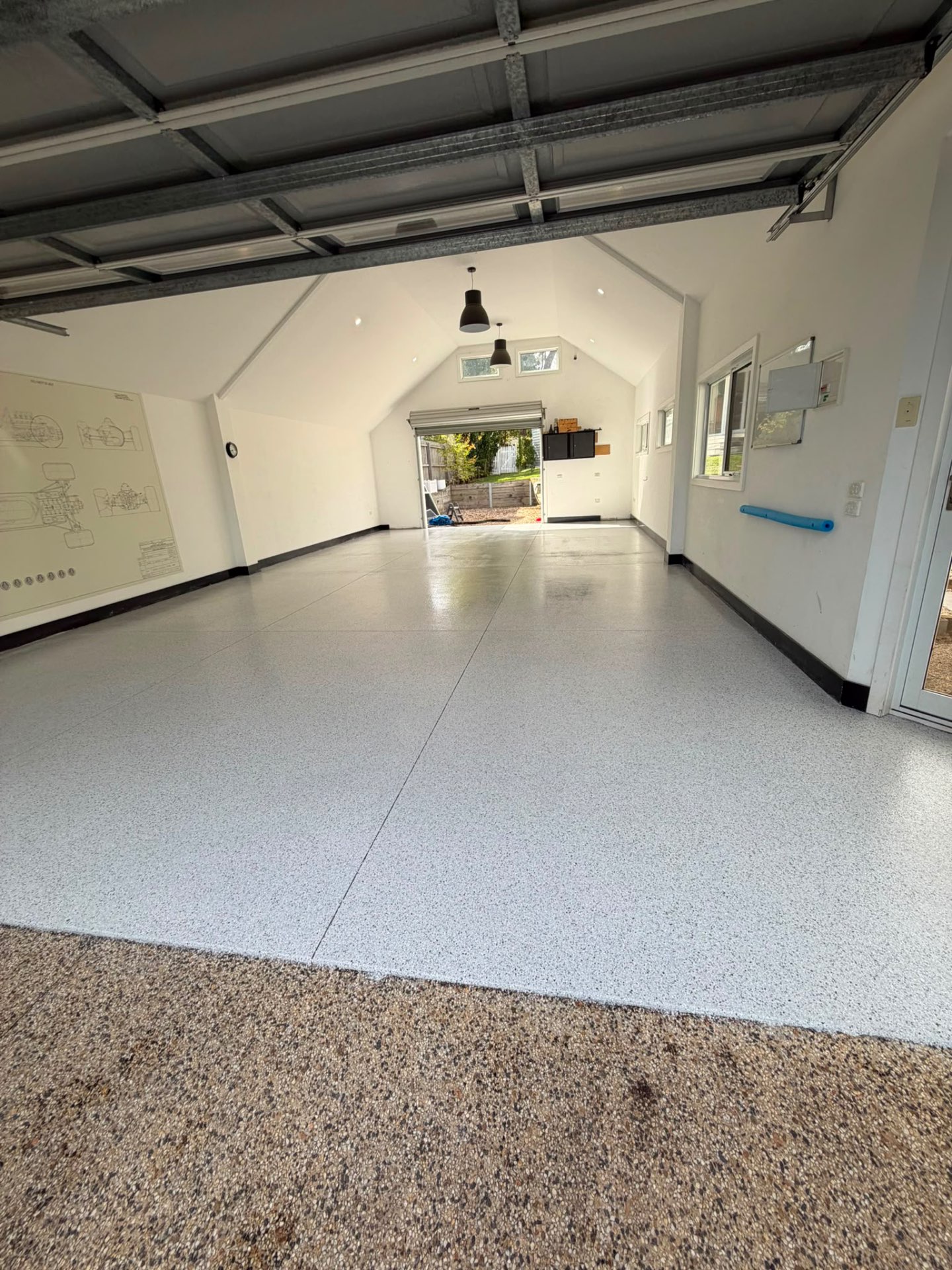
Machinery loads, impact and anchoring
Static machine weight is rarely the problem. Concrete is very good in compression, and a resin floor transfers load straight through to the slab. What damages plant floors is everything that happens around the machines — pallets dropped from a fork, tooling and dies set down on bare surface, jacks and skates used during equipment moves, and the concentrated edge pressure at machine feet and levelling pads.
In those zones we move away from rolled films and into troweled, aggregate-filled builds, typically 4 to 9 mm of mortar-based epoxy or urethane cement. That thickness spreads impact energy and resists gouging in a way a 20-mil coating cannot. Around anchored equipment we detail the base plate perimeter so that a future line change or machine relocation does not tear the surrounding floor apart.
Where a plant plans reconfiguration within the coating's life — increasingly common in contract manufacturing — we specify with that in mind, keeping the heavy build continuous through the likely footprint rather than mapped tightly to today's equipment layout.
- Troweled mortar builds at machine bases and drop zones
- Detailed perimeters around anchors and levelling pads
- Continuous heavy build through areas likely to be reconfigured
- Slab and joint assessment before any system is quoted
Chemical exposure and abrasion resistance
Chemical resistance is not a single property, and marketing sheets that claim it without qualification should be treated with suspicion. A resin that shrugs off machine oil may soften under lactic acid; a system that tolerates caustic wash may fail against a solvent. What matters is the specific chemistry your process puts on the floor, in the concentration it lands and at the temperature it lands.
Practically, three families cover most GTA plants. Standard 100% solids epoxy handles oils, coolants, hydraulic fluids and mild alkalines at ambient temperature and represents the best value across general production and assembly space. Novolac epoxy steps up for concentrated acids and aggressive solvents in plating, chemical and battery-adjacent processes. Urethane cement is the answer wherever heat, steam or thermal shock are present — food and beverage production, bottling, rendering and any bay that gets a hot wash-down.
Abrasion is a separate axis. Metal swarf, glass, ceramic dust and dry powders are far harder on a floor than the same volume of traffic on a clean surface, because grit turns every wheel pass into grinding. Where abrasion dominates, we increase the aggregate content and the film build rather than chasing a harder resin, because a brittle floor chips where a tough one wears.
Surface preparation and downtime planning
Every failed plant floor we are asked to diagnose failed at preparation, not at product selection. Coatings do not bond to laitance, curing compound, old sealer, oil-saturated concrete or a closed power-trowelled surface. Years of process oil migrating into a slab must be drawn out or ground through before anything is applied.
Our sequence: shot blast or diamond grind to a measured concrete surface profile, degrease and treat contaminated areas, rebuild spalls and low spots with fast-set mortar, chase and fill cracks, detail joints, and test moisture. Older GTA industrial slabs frequently have no vapour barrier, and a non-breathable coating over an actively transmitting slab will blister within a year unless a moisture-tolerant primer is specified. Testing costs almost nothing; skipping it costs the entire floor.
Downtime is planned in parallel with the technical work. We break the plant into cells, agree the sequence with production planning, and commit to hand-back times per cell. Containment walls and negative-pressure dust extraction keep adjacent lines running, and low-odour, low-VOC systems are specified where staff or product occupy neighbouring space.
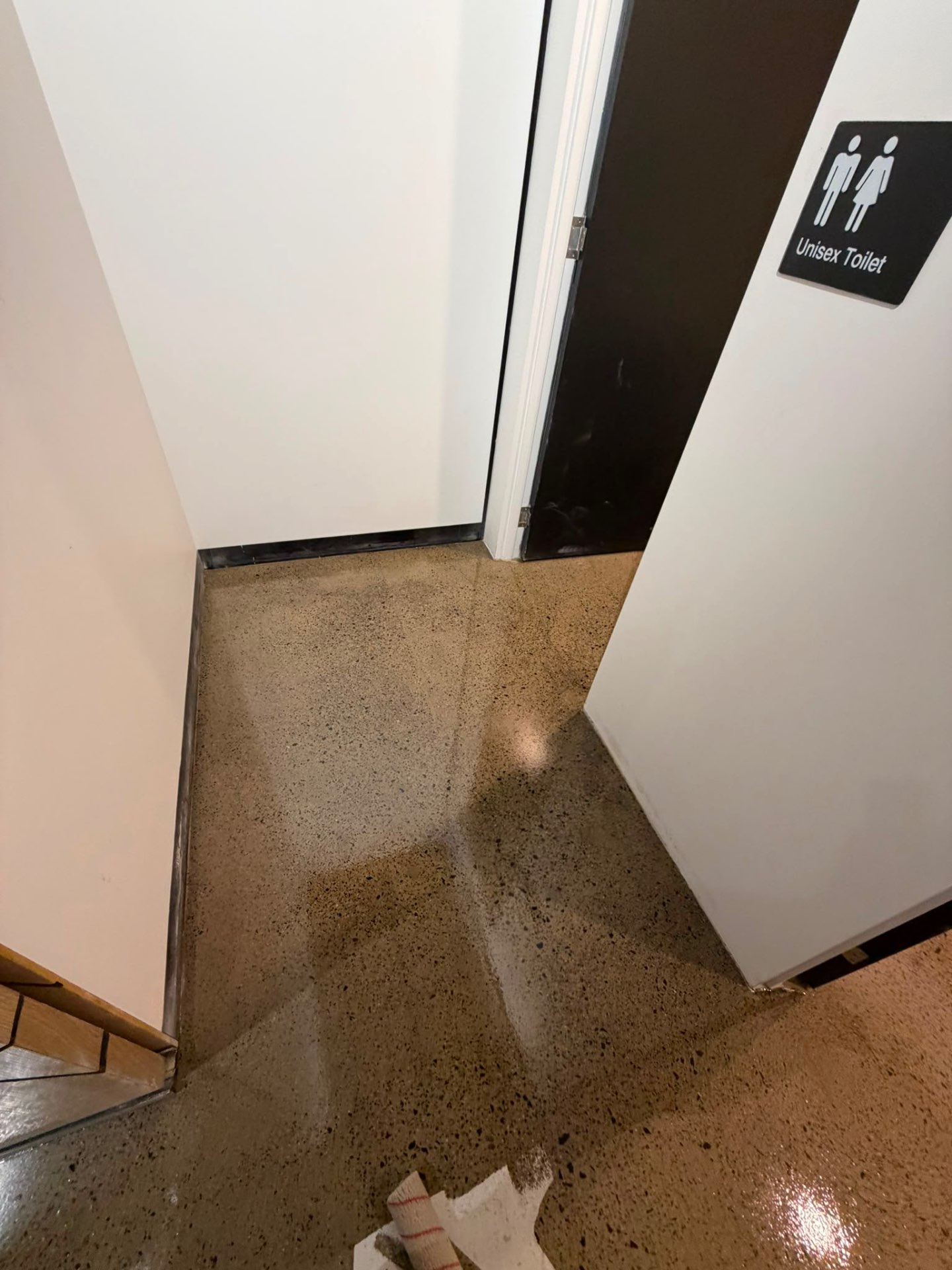
Worker safety, wayfinding and compliance
The floor is one of the few controls that works continuously without anyone remembering to use it. Slip resistance is engineered into the topcoat by broadcasting aggregate at a profile matched to the area — light where floors stay dry and are mopped, heavy where coolant, oil or wash-down water is routine. Getting this wrong in either direction has consequences: too little grip creates incidents, too much makes a wash-down bay impossible to clean properly.
Marking is applied as pigmented resin beneath the clear coat, so it becomes part of the floor rather than tape that lifts in a month. Typical layouts separate pedestrian routes from equipment traffic, define machine clearance and no-stand zones, mark emergency egress, and keep panels, eyewash stations and fire equipment visibly clear.
Brightness matters more than most plants expect. A light-reflective floor lifts perceived light levels substantially, improving visibility around moving equipment and reducing the shadowing that makes spills and dropped hardware hard to see.
Maintenance that protects the investment
Auto-scrub on a defined cycle with a neutral-pH cleaner. Aggressive degreasers and high-alkaline chemistry strip gloss and shorten topcoat life; where your process genuinely requires them, we specify a resin that tolerates them rather than asking your team to change how they clean.
Control grit at the doors and between zones. Tracked-in sand, salt and process dust are the primary abrasive agents in most plants, and matting plus a scheduled sweep in transition areas measurably extends floor life.
Inspect the traffic lanes annually. A thinning topcoat shows as a change in sheen long before substrate appears, and a scuff-sand and recoat at that stage costs a fraction of a rebuild. We hand over a written system record listing every product, thickness and cleaning recommendation at completion, and back our workmanship with a 10-year warranty where the schedule is followed.
- Neutral-pH auto-scrub on a defined cycle
- Matting and grit control at doors and zone transitions
- Annual wear-lane inspection and early recoat
- Written system record handed to your maintenance team
Manufacturing facility flooring at a glance
- Who it is for
- Plant managers, manufacturing and processing companies, production supervisors, facility engineers
- Core problems solved
- Impact and machinery damage, chemical attack, abrasion wear, wash-down failure, slip risk, downtime
- System options
- 100% solids epoxy, novolac epoxy, mortar-based troweled builds, urethane cement, polyaspartic topcoats
- Preparation
- Shot blast or diamond grind, degrease, spall and crack repair, joint detailing, moisture testing
- Return to service
- 12–24 hours with fast-cure systems; 48–72 hours with standard epoxy builds
- Typical service life
- 10–20 years with topcoat renewal in traffic lanes
- Service area
- Toronto, Mississauga, Brampton, Vaughan, Markham, Scarborough and the wider GTA
Manufacturing Facility Flooring FAQs — Toronto & GTA
Explore related flooring systems and service areas
Industrial Epoxy Flooring
The core service behind our heavy-duty plant installations.
Warehouse Floor Coatings
For the storage and shipping side of your facility.
Commercial Epoxy Flooring
Offices, labs and front-of-house space attached to the plant.
Concrete Grinding & Sealing
Surface preparation done to a measured concrete profile.
Warehouse Flooring Solutions
Forklift-rated systems for distribution and logistics buildings.
Epoxy Flooring in Mississauga
Serving the industrial corridor around Pearson and the 401.
Book a free plant floor assessment
Send us your area, process chemistry, equipment types and available production windows. We will walk the slab, test moisture and return a phased specification your production planner can actually work with.
Call: (647) 970-8226
Email: Buildwellflooringsolutions@gmail.com
Shop: 7030 Woodbine Ave, Markham, ON L3R 6G2
Free estimates · 10-year workmanship warranty · Fully insured
Prefer email? Use our contact page.
Serving Toronto & the GTA · Free estimates · 10-year workmanship warranty
Get a Free Estimate