
Automotive Shop Flooring for Repair Shops, Dealerships and Body Shops
Buildwell installs oil-resistant, slip-rated resin floors for automotive repair shops, dealership service centres, tire shops and body shops across the Greater Toronto Area — bay by bay, around your booked work, with a finish that still looks professional when a customer walks past it.
- Oil, coolant and brake fluid resistant surfaces
- Hot-tire rated polyaspartic topcoats
- Slip resistance tuned bay by bay
- Coating installed around existing hoists
- Bay-by-bay scheduling around booked work
- 10-year workmanship warranty
Why automotive floors fail faster than other commercial floors
An automotive shop puts a combination of stresses on a floor that almost no other commercial environment does. Hot tires roll onto it directly off the highway. Petroleum products, solvents and battery electrolyte land on it daily. Jack stands, transmission jacks and dropped tooling hit it with concentrated point loads. Winter brings salt brine in on every vehicle. And unlike a warehouse, part of the floor is on display to paying customers.
Bare concrete loses that fight quietly. Oil migrates into the slab until the floor is permanently dark and no degreaser touches it. Salt brine attacks the surface and starts pitting and spalling near the doors. Dust from the eroding surface settles on tools, parts and vehicle interiors. By the time a shop owner calls us, the floor usually reads as neglected even when the business is not.
A properly specified resin floor changes the shop economically and visually. Spills sit on the surface and wipe away, the slab is protected from chloride and chemical attack, the space is noticeably brighter under the same lighting, and a customer glancing into the service area sees a professional operation. Shops that coat customer-facing bays almost always report the appearance return before the durability one.
Matching the system to the type of shop
Not every automotive business needs the same floor. The right specification depends on what happens in the bay, how much of it the customer sees, and how hard the surface gets hit.
General repair shops
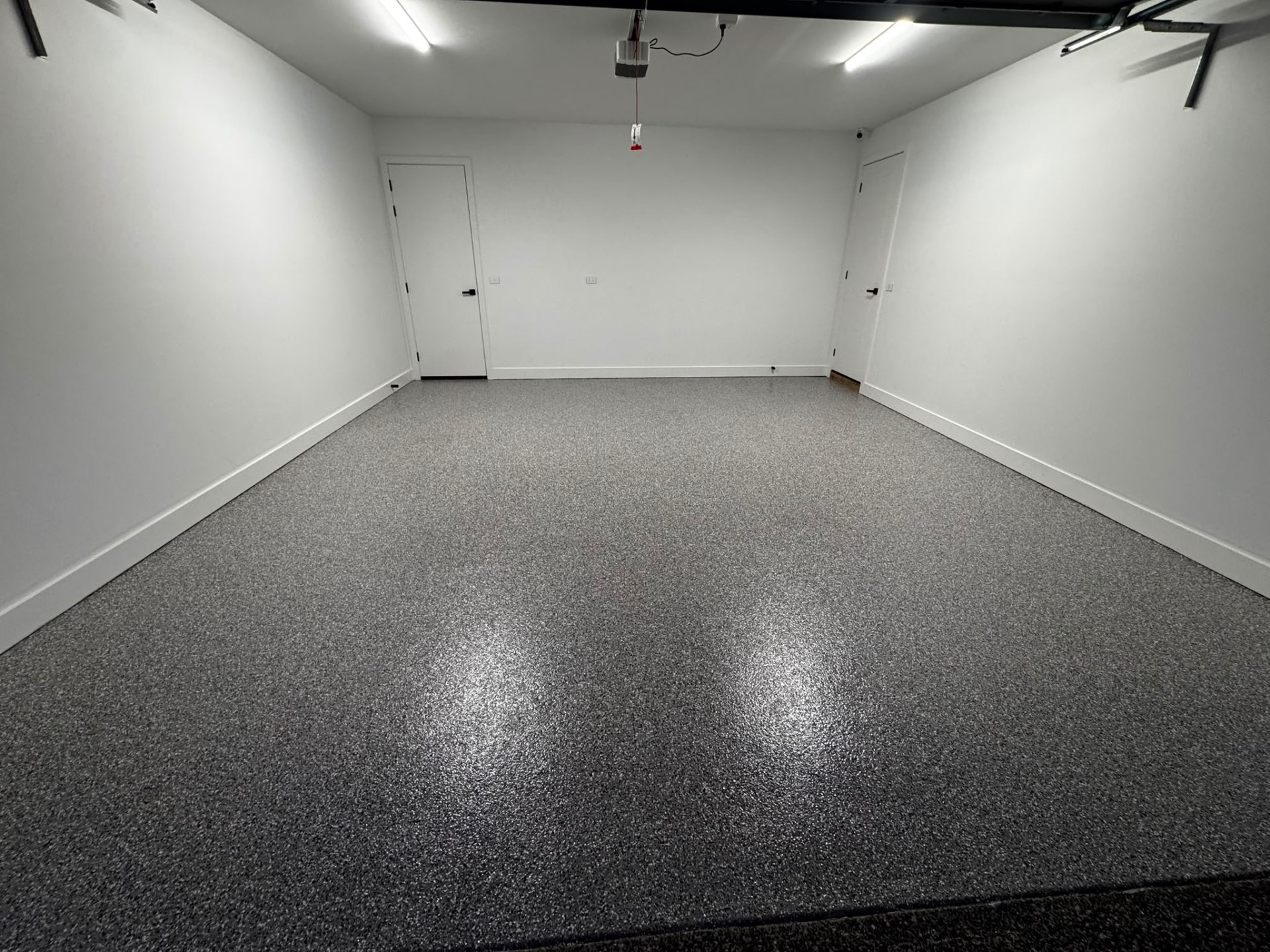
A 100% solids epoxy base with a flake broadcast and polyaspartic topcoat is the workhorse. The flake hides tire scuffing and small debris between cleans, provides natural slip texture, and handles oil, coolant and brake fluid without staining.
Dealership service centres
Solid colour epoxy with crisp line striping for bay numbering and pedestrian routes, and a light-reflective finish that keeps the service drive bright. Appearance standards are higher here because customers walk the space, so we detail edges, drains and columns to a finish level closer to a showroom.
Tire shops
Constant tire handling and rolling means abrasion and scuff marking dominate. A mid-tone flake or heavily pigmented system with an abrasion-rated topcoat keeps the floor looking clean rather than showing every black mark, and a heavier grip profile is specified at the door thresholds.
Body and paint shops
Solvent exposure, sanding dust and masking tape make chemical resistance and cleanability the priorities. Chemically resistant epoxy with a smooth, easily swept finish suits prep areas; we keep aggregate light so dust does not lodge in the texture near paint work.
Oil resistance, chemical spills and cleanability
Chemical resistance is the reason most shops call, and it is worth understanding what it means in practice. A cured 100% solids epoxy with a polyaspartic topcoat is non-porous, so motor oil, transmission and brake fluid, antifreeze, gasoline, diesel and lithium-ion electrolyte cannot penetrate. They sit on the surface until someone wipes them up, and the floor underneath is unchanged.
That single property drives most of the operational benefit. Cleaning becomes a wipe instead of a scrub. Fluid spills stop becoming permanent features of the shop. Parts and tools stay cleaner because the floor is not shedding contaminated dust. And a shop that can clean its floor to a visible standard passes customer and manufacturer inspections without a scramble.
Cleanability compounds over time. Bare concrete gets progressively darker year over year because every spill adds to what is already inside it. A sealed floor stays at the standard you clean it to, which is why five-year-old coated shops still photograph well and five-year-old bare ones do not.
- Non-porous to oil, fuel, coolant and brake fluid
- Battery electrolyte and EV coolant resistant
- Salt brine and chloride resistant at door thresholds
- Wipe-clean surface instead of scrubbing bare concrete
Slip resistance and safety in a working shop
A shop floor is wet or oily at some point in nearly every shift, so slip resistance is a specification decision rather than an afterthought. We broadcast aluminum-oxide aggregate into the topcoat and adjust the profile by area: heavier grip at overhead doors where slush and rain arrive, in wash bays and around tire machines; lighter grip in customer-facing areas and along walkways where appearance and easy mopping matter more.
Over-texturing is a real mistake and one we see on floors installed by general contractors. Too coarse a profile traps grease and grit, becomes unpleasant to clean, and shortens mop and scrubber life. The goal is measured traction wet, not the roughest surface possible.
Marking is applied as pigmented resin beneath the clear coat so it becomes part of the floor. Common layouts number the bays, define pedestrian routes from the service drive to reception, mark hoist clearances and keep compressors, panels and fire equipment visibly clear.
Installation around a working shop
Very few automotive businesses can close. Almost all of our shop work is phased bay by bay, and the scheduling conversation happens before the technical one.
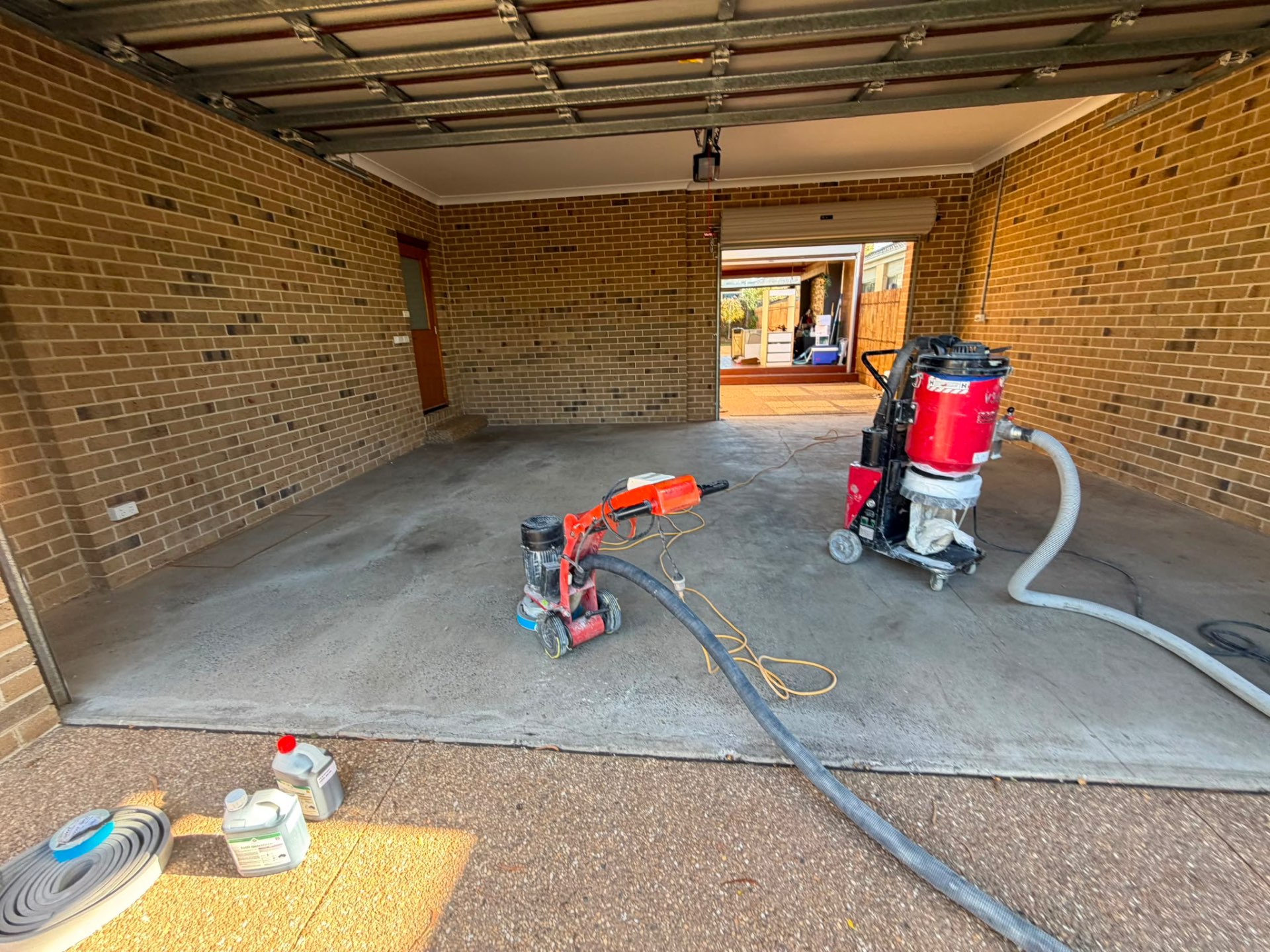
A typical bay takes two to three days: diamond grind the slab to a measured profile and degrease the oil-saturated areas — which in an old shop can run surprisingly deep — then repair spalls, chase and fill cracks, prime, apply the epoxy build, broadcast flake or aggregate if specified, and finish with the polyaspartic topcoat. Fast-cure chemistry means foot traffic within hours of the final coat and vehicle traffic in roughly 24.
We work with containment and dust extraction so adjacent bays keep operating, coordinate around lifts rather than requiring removal, and commit to hand-back times per bay. For smaller independent shops, a Friday-to-Monday programme often covers the whole floor with only one lost working day.
Costs, limitations and honest trade-offs
A resin floor is not the right answer everywhere and it helps to know the limits up front. If your slab is actively settling or structurally cracked, a coating will follow the movement and telegraph it — the concrete needs addressing first, and we will say so at assessment rather than after installation. If your slab has no vapour barrier and is transmitting moisture, a standard system will blister; a moisture-tolerant primer solves it but adds cost, and we test rather than assume.
Budget follows condition more than area. A clean, sound slab in a newer building is straightforward. Thirty years of embedded oil, failed patch repairs and door-threshold spalling means the preparation and repair line is a real share of the quote. That work is not padding: it is the part that determines whether the floor lasts a decade or two winters.
Where a shop genuinely cannot justify a full build — a leased unit with a short remaining term, or a back-of-house storage area — a densify-and-seal keeps the concrete look, stops dusting and costs substantially less. We would rather specify that honestly than sell a system the business will not be around to benefit from.
Keeping an automotive floor looking professional
Maintenance is straightforward. Sweep or auto-scrub on a regular cycle with a neutral-pH cleaner, and deal with fluid spills the same day — not because the floor will stain, but because a spill left underfoot is a slip risk and gets tracked through the shop.
Control grit at the overhead doors with matting or a scheduled sweep. Road sand and salt are abrasive under tires and are the main thing that wears a shop floor's gloss in the GTA. Use dollies and pads under jack stands and heavy tooling where practical.
Plan on a scuff-sand and recoat of the hoist approaches and door lanes somewhere in years six to ten. Those zones take the majority of the wear, and refreshing them alone restores the whole floor's appearance for a small fraction of the original cost. We hand over the written system record at completion so any future work matches what is already down.
- Neutral-pH cleaning, no harsh degreasers
- Same-day spill wipe-up as a shop habit
- Matting and grit control at overhead doors
- Targeted recoat of hoist and door lanes years later
Automotive shop flooring at a glance
- Who it is for
- Independent repair shops, dealership service centres, tire shops, body and paint shops, fleet garages
- Core problems solved
- Oil staining, hot-tire pickup, salt and chloride pitting, concrete dusting, slip risk, poor customer impression
- System options
- Flake epoxy with polyaspartic topcoat, solid colour epoxy, chemically resistant epoxy, densify and seal
- Preparation
- Diamond grinding to profile, hot degrease of oil-saturated areas, spall and crack repair, priming
- Return to service
- Foot traffic within hours of topcoat; vehicles typically at 24 hours
- Typical schedule
- 2–3 days per bay phased, or a long weekend for a small shop
- Service area
- Toronto, Mississauga, Brampton, Vaughan, Markham, Scarborough and the wider GTA
Automotive Shop Flooring FAQs — Toronto & GTA
Explore related flooring systems and service areas
Commercial Epoxy Flooring
Our core commercial service, including service bays and workshops.
Flake Epoxy Flooring
The finish most repair and tire shops choose for scuff resistance.
Industrial Epoxy Flooring
Heavier systems for fleet garages and truck maintenance bays.
Concrete Grinding & Sealing
Preparation, degreasing and the lower-cost dust-control option.
Showroom Epoxy Flooring
For the dealership showroom attached to your service centre.
Epoxy Flooring in Scarborough
Serving repair shops and service centres across east Toronto.
Book a free shop floor assessment
Tell us how many bays, what condition the slab is in and when you can release them. We will walk the shop, check for oil saturation and moisture, and return a bay-by-bay plan that keeps you booking work.
Call: (647) 970-8226
Email: Buildwellflooringsolutions@gmail.com
Shop: 7030 Woodbine Ave, Markham, ON L3R 6G2
Free estimates · 10-year workmanship warranty · Fully insured
Prefer email? Use our contact page.
Serving Toronto & the GTA · Free estimates · 10-year workmanship warranty
Get a Free Estimate