
Industrial Epoxy Flooring for Toronto Manufacturing and Distribution Facilities
Buildwell installs heavy-duty resinous floor systems in manufacturing plants, distribution centres and industrial buildings across Toronto and the GTA. Every specification starts with slab testing and ends with a documented, forklift-rated floor backed by a 10-year workmanship warranty.
- Forklift, pallet-jack and skid-steer rated build-ups
- Moisture vapour testing before every quote
- Novolac and urethane cement for aggressive chemistry
- Shot-blast and diamond-grind surface preparation
- Line striping, safety zones and OSHA-grade slip resistance
- Night shift, weekend and plant-shutdown scheduling
What industrial epoxy flooring actually is
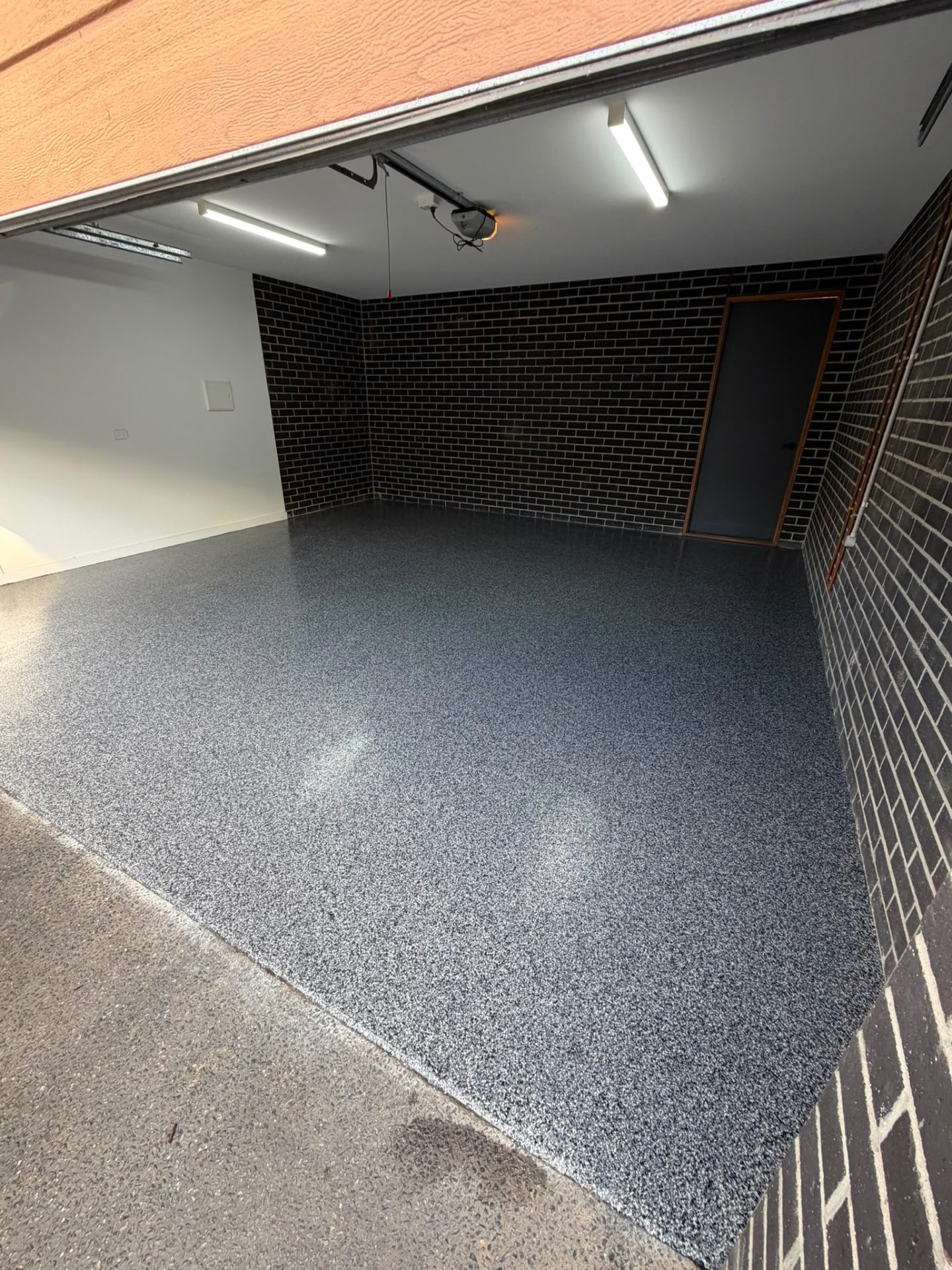
Industrial epoxy flooring is a bonded resin system applied directly to a prepared concrete slab. It is not paint and it is not a floor covering — it becomes part of the slab. A typical system is built in layers: a penetrating primer that locks into the open pores of the concrete, one or more body coats of 100% solids epoxy or epoxy mortar that provide thickness and impact resistance, and a topcoat that determines chemical resistance, gloss and slip profile.
The reason industrial facilities choose resinous flooring over bare or sealed concrete is simple: an uncoated slab is porous. It absorbs oil, hydraulic fluid and process chemicals, it dusts under traffic, and it spalls where forklift wheels turn. A properly specified epoxy build seals the surface, distributes point loads, and gives you a floor you can actually clean.
Where facilities go wrong is treating every industrial floor as the same product. A dry-storage warehouse, a metal-stamping plant and a food-grade production room all need different resin chemistry, different thickness and different topcoats. Our job is to identify which one you have before anything gets mixed.
Who these floors are built for
The facilities we coat most often across Toronto, Mississauga, Vaughan and Brampton fall into a handful of categories, each with a different failure mode we design against.
Manufacturing plants
Point loads from presses and CNC equipment, dropped tooling, cutting fluids and thermal cycling. These floors need impact-tolerant mortar builds in production aisles and chemical-resistant topcoats near coolant zones.
Distribution and 3PL warehouses
Constant forklift traffic on fixed routes, dust control for inventory protection, and clear line striping for pedestrian safety. Wear concentrates in turning circles and dock approaches, so we upgrade those areas rather than the whole floor.
Food and beverage processing
Hot wash-down, lactic and citric acid, and sanitation standards. Urethane cement handles thermal shock that would craze a standard epoxy, and coved integral bases eliminate the dirt-trapping wall joint.
Fleet, service and equipment bays
Oil, diesel, road salt and steel-wheeled equipment. Oil-resistant epoxy with an aliphatic topcoat keeps the floor cleanable and the shop bright without constant repainting.
Forklift traffic and load-bearing performance
Forklift damage is rarely caused by the weight of the truck — it is caused by concentrated shear at the contact patch when a loaded truck turns. Hard polyurethane and steel wheels transmit that shear straight into the coating. A thin roll-on film has nothing to absorb it and tears at the edges; a troweled epoxy mortar has enough mass and compressive strength to spread the load into the slab.
For heavy forklift environments we specify a quartz-filled epoxy mortar at 1/8" or a urethane cement at 3/16", both with compressive strengths well above the concrete beneath them. Control joints in the traffic path are treated with a semi-rigid polyurea filler so the joint edge is supported rather than being a hard shoulder that spalls under wheels.
We also look at where the trucks actually go. Mapping your aisle layout lets us put the expensive build where the abuse is and a lighter, less costly system under racking and in low-traffic storage — which usually saves more than it costs.
- Quartz-filled mortar in aisles and turning circles
- Semi-rigid polyurea joint fill to protect joint edges
- Reinforced dock plate and ramp transitions
- Traffic mapping so budget goes where wear happens
Chemical resistance: matching resin to exposure
Not all epoxies resist the same chemistry, and the honest answer is that no single system resists everything. Standard bisphenol-A epoxy is excellent against oils, fuels, dilute acids and alkalis. Novolac epoxy steps up for concentrated acids and many solvents. Urethane cement tolerates thermal shock and organic acids that would soften epoxy. Polyaspartic topcoats add UV stability and abrasion resistance but are not a substitute for chemical build.
Before we quote, we ask for the actual list: what spills, at what concentration, at what temperature, and how long before it gets cleaned up. Contact time matters as much as concentration — a splash wiped in five minutes is a different problem from a puddle that sits overnight under a machine.
Where a facility has one aggressive zone inside an otherwise ordinary plant, we isolate it. A containment area with a novolac topcoat and coved curbing costs far less than upgrading the entire floor to the worst-case spec.
Concrete preparation is the whole job
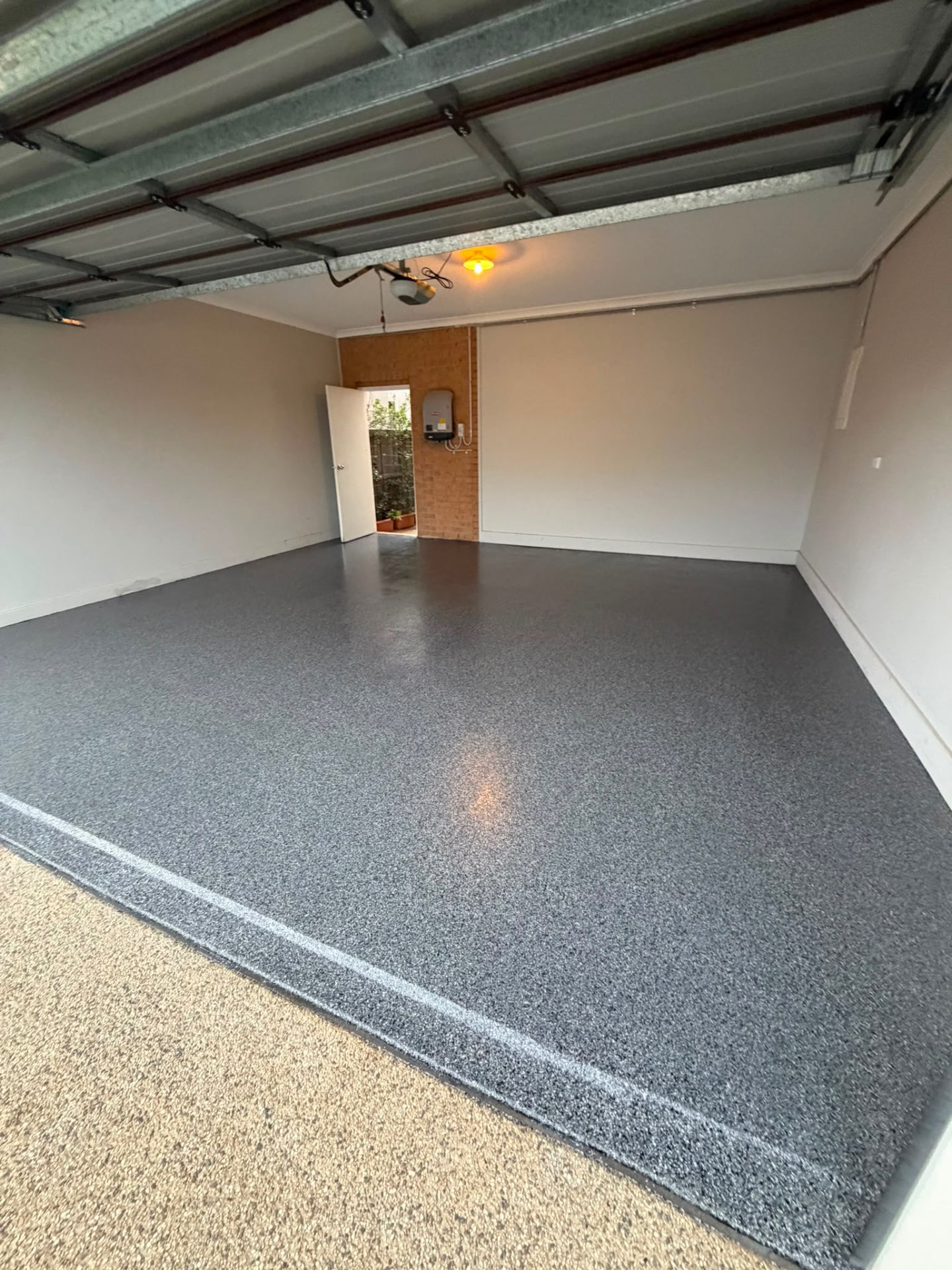
Roughly 80% of resinous floor failures trace back to preparation, not product. A coating can only be as sound as the surface it bonds to, so this is where our crews spend most of their time on site.
We begin with a moisture vapour test and a bond assessment. The slab is then mechanically profiled — diamond grinding for most interiors, shot blasting for large open areas or heavily contaminated concrete — to an ICRI CSP 3 to CSP 5 profile depending on system thickness. Acid etching is never used; it leaves salts behind and cannot produce a consistent profile.
Repairs come next: cracks are chased out and filled with an epoxy or polyurea, spalls and pits are rebuilt with a fast-set mortar, and low spots that would hold water are levelled. Control joints are honoured, not bridged, so the slab can still move without cracking the coating. Only then does the primer go down.
For an in-depth look at our preparation methods, see our dedicated page on concrete grinding and sealing — the same surface preparation discipline underpins every coating we install.
- Calcium chloride or in-situ RH moisture testing
- Shot blasting and diamond grinding to CSP 3–5
- Crack chasing, spall rebuild and levelling
- Documented profile and primer records at handover
Long-term durability, maintenance and recoating
A correctly specified and installed industrial floor should give 10 to 20 years of service in most GTA facilities, with the topcoat as the wear item rather than the whole system. That is intentional: when the topcoat dulls or thins in traffic lanes, it can be abraded and recoated over a weekend, restoring the floor at a fraction of replacement cost.
Day-to-day maintenance is straightforward. Auto-scrub with a neutral-pH cleaner, avoid aggressive citrus or high-alkaline degreasers that soften topcoats, and clean aggressive spills promptly. Rubber-tyred equipment and non-marking wheels extend topcoat life noticeably. Rigid steel wheels and dragged pallets shorten it.
At project completion we hand over a system record: products used, thickness, primer, topcoat and recommended cleaning chemistry. That document is what lets any competent contractor — us or anyone else — recoat correctly years later. Our workmanship on industrial installations is backed by a 10-year warranty where the specified system and maintenance schedule are followed.
Limitations you should know before you buy
We would rather set expectations than oversell. Epoxy systems are rigid; they will telegraph a moving structural crack no matter how well the crack is filled, so slabs with active differential settlement need structural remediation first. Standard epoxy ambers under direct UV, which is why exterior loading docks get an aliphatic polyaspartic or urethane topcoat instead.
Very smooth gloss finishes become slippery when wet — in wash-down and freezer-adjacent areas we broadcast aggregate for grip and accept a less glossy, harder-to-mop surface as the trade-off. And no coating will fix a slab with excessive moisture drive unless a mitigation primer is used, which adds both cost and a day to the schedule.
If your facility has one of these conditions, we will say so at the estimate stage and price the correct solution rather than the cheapest one.
Industrial epoxy flooring at a glance
- Best suited to
- Manufacturing plants, distribution centres, industrial and processing facilities
- Typical thickness
- 12–20 mils roll-applied; 1/8"–1/4" troweled mortar or urethane cement
- Traffic rating
- Forklift, pallet jack, skid steer, steel-wheeled carts
- Chemical resistance
- Oils, fuels, coolants, dilute acids/alkalis; novolac or urethane cement for aggressive exposure
- Typical service life
- 10–20 years with topcoat renewal in wear lanes
- Install window
- 3–4 days standard; 24–36 hours with fast-cure systems; night and weekend shifts available
- Service area
- Toronto, Mississauga, Vaughan, Brampton, Markham, Scarborough and the wider GTA
Industrial Epoxy Flooring FAQs — Toronto & GTA
Explore related flooring systems and service areas
Manufacturing Facility Flooring
Industry guide for plant managers: machinery loads, chemistry and downtime.
Warehouse Floor Coatings
Dust control, safety marking and restoration for high-traffic warehouse slabs.
Commercial Epoxy Flooring
Our core commercial system for GTA facilities of every size.
Solid Colour Epoxy Flooring
The workhorse finish for plants, service bays and back-of-house areas.
Concrete Grinding & Sealing
Surface preparation and densified, sealed concrete as a standalone finish.
Epoxy Flooring Subcontractor
For general contractors bidding new industrial builds and retrofits.
Epoxy Flooring in Mississauga
Industrial corridors along Dixie, Meadowvale and the airport lands.
Get an industrial flooring specification and estimate
Send us your square footage, traffic type and any chemical exposure. We will attend site, test the slab and return a written specification with a fixed price — no obligation, no charge.
Call: (647) 970-8226
Email: Buildwellflooringsolutions@gmail.com
Shop: 7030 Woodbine Ave, Markham, ON L3R 6G2
Free estimates · 10-year workmanship warranty · Fully insured
Prefer email? Use our contact page.
Serving Toronto & the GTA · Free estimates · 10-year workmanship warranty
Get a Free Estimate