
Flake Epoxy Flooring for Toronto Garages, Basements and Commercial Spaces
Flake epoxy is the most widely chosen decorative floor system we install across the GTA — a thick, chip-broadcast build that hides dirt, resists hot tyres and road salt, and comes in a blend you choose. Free estimates with physical samples on site.
- 25–40 mil built film — several times a single-colour coat
- Custom chip blends and 1/4" to 1" flake sizes
- Natural slip resistance from the chip texture
- Hides dust, tyre marks and surface imperfections
- Resists road salt, oil, battery acid and hot-tyre pickup
- Renewable clear topcoat instead of full replacement
How a flake epoxy floor is built
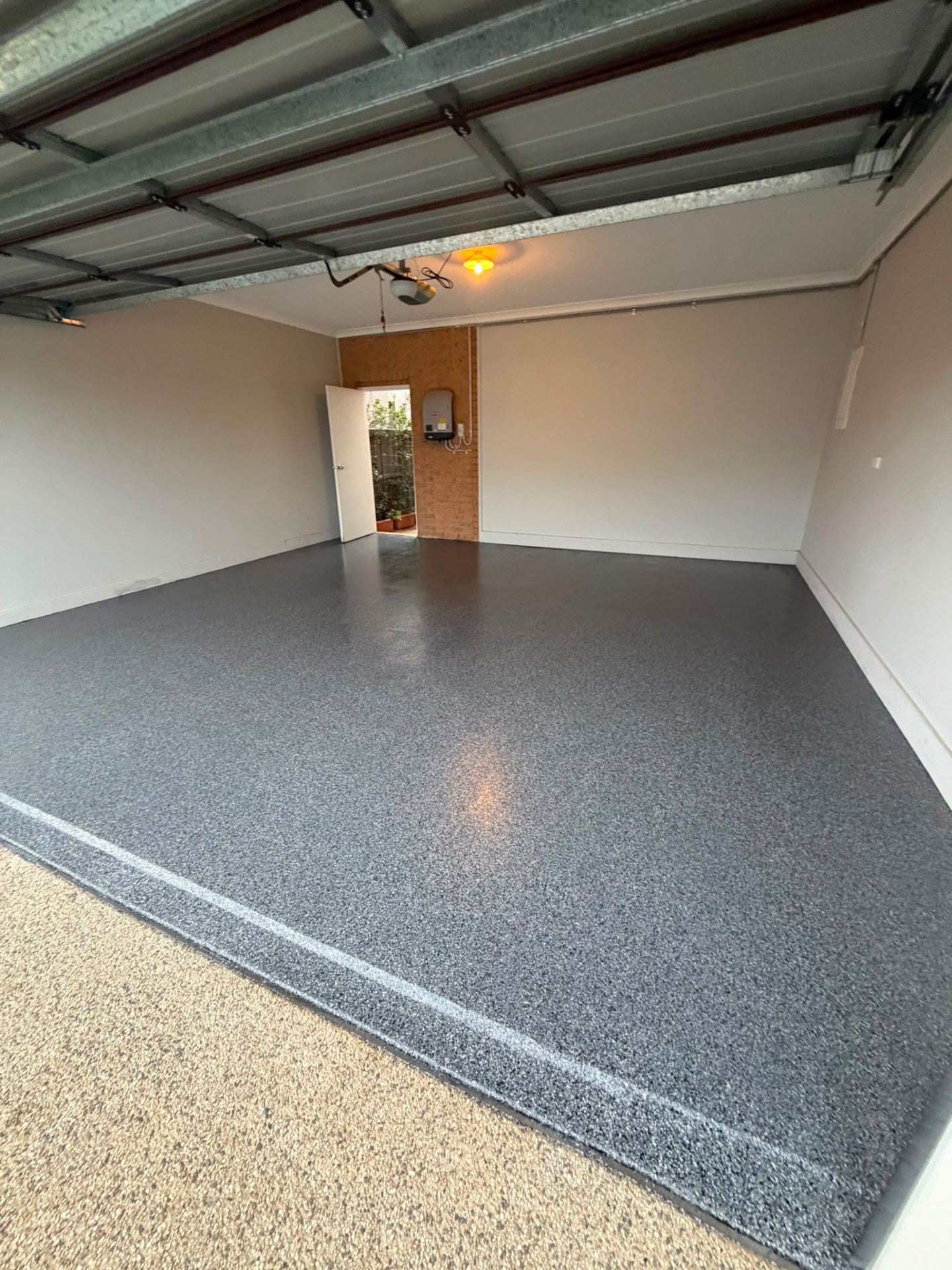
The system is assembled in layers over a mechanically prepared slab. First a penetrating primer bonds into the open concrete. Next, a pigmented 100% solids epoxy base coat goes down, and while it is still wet the installer broadcasts vinyl chips into it — to full rejection for a complete chip surface, or at a controlled density for a partial, more open look.
Once cured, the excess loose flake is scraped and vacuumed off, and the surface is abraded flat. That step is what separates a professional flake floor from a rough one: unscraped chip edges stand proud and feel like sandpaper. Finally, one or two clear coats — polyaspartic in most of our installs — are applied to encapsulate the flake and provide the wear surface.
The result is a monolithic, seamless floor with no grout lines, no seams and nothing for water to get under. Because the topcoat is the sacrificial layer, the floor can be renewed years later by abrading and recoating without disturbing the decorative layer at all.
Why homeowners across the GTA choose flake
The practical reason is that flake floors do not look dirty. A solid colour shows every footprint, drip and tyre scuff; a chip blend visually absorbs all of it, which matters enormously in a garage that also serves as workshop, storage and winter entryway.
The second reason is durability under Toronto conditions. Road salt brine is the primary destroyer of residential garage slabs here — it wicks into porous concrete, freezes and spalls the surface apart. A flake system is fully waterproof and chloride-resistant, so salt water sits on top and mops away. Combined with a polyaspartic topcoat rated well beyond typical hot-tyre temperatures, it addresses the two failure modes that ruin DIY kits within a winter or two.
The third is that it is genuinely a finished-room surface. Homeowners converting basements, home gyms and workshops choose flake because it delivers a hard, cleanable, attractive floor for less than most tile installations, with none of the grout maintenance.
- Conceals dust, salt residue and tyre marks
- Waterproof and chloride-resistant for winter
- Seamless — no grout lines or joints to clean
- Comfortable, hard-wearing surface for gyms and workshops
Colour blends, chip sizes and finish options
Chip blends are mixed from individual colours rather than pulled from a fixed catalogue, so the palette is effectively open. Neutral greys and charcoals with black and white accents remain the most requested in the GTA; earth-tone blends suit basements and finished living space; brighter or brand-matched blends appear in showrooms and retail.
Chip size changes the character more than most people expect. Quarter-inch flake reads as a fine, granite-like speckle from standing height and suits smaller rooms. One-inch flake produces a bolder, terrazzo-like pattern that works well across large open floors. Mixed sizes give depth. We always bring physical samples to the estimate, because chip blends photograph very differently from how they appear underfoot.
Finish level is a separate decision. A high-gloss clear coat maximizes light reflection and looks striking in a showroom; a satin finish shows less dust and fewer scratches and is what most homeowners choose once they see both side by side.
Garage applications
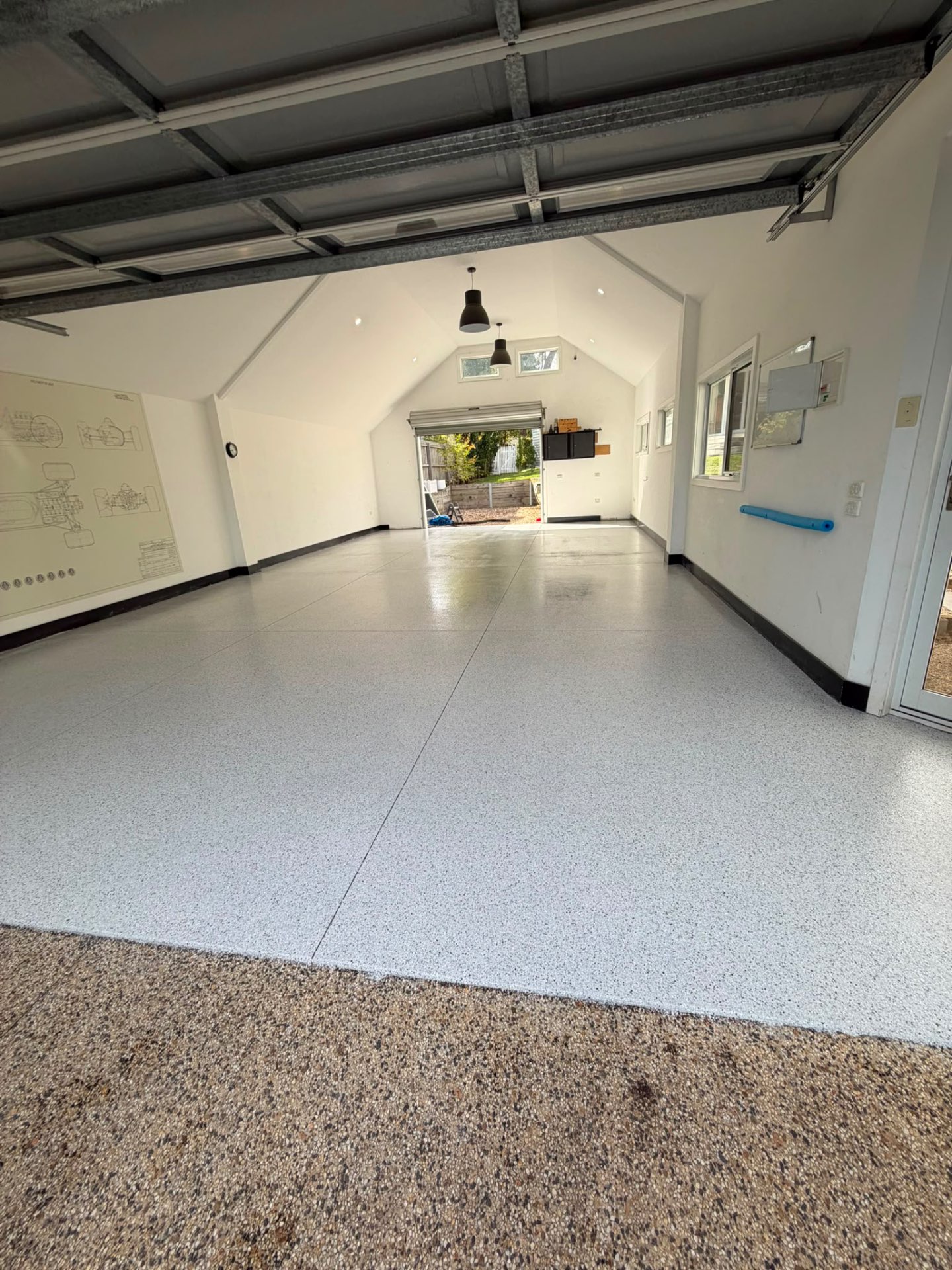
Garages are where flake epoxy performs at its best, because the environment plays to every strength of the system. Vehicle traffic, dropped tools, road salt, oil drips and freeze-thaw cycling are all handled by a properly prepared, fully built flake floor.
The critical variable is preparation, not product. We diamond-grind the slab to remove old paint, sealer and oil-saturated surface, chase and fill cracks with polyurea, rebuild spalled areas and pits, and prime before any decorative work begins. Garages that have previously had a DIY kit applied usually need the most aggressive grinding, since those coatings sit on the surface rather than bonded into it.
Most residential garages are completed in three to four days including cure, and we schedule so vehicles can return on a defined date rather than an approximate one. Our garage installations are backed by a 10-year workmanship warranty, including hot-tyre pickup.
Commercial applications
In commercial settings, flake earns its place where a floor needs to be both hard-wearing and presentable. Veterinary clinics, dental and medical offices, commercial kitchens, breweries, gyms, auto dealerships and retail back-of-house all use it regularly.
The specification changes for these environments. Commercial builds usually receive a heavier broadcast and an additional topcoat pass for abrasion life, and where the space is subject to wash-down we add integral coved bases so the floor turns up the wall with no dirt-trapping joint. Slip resistance is specified deliberately rather than left to the chip texture alone.
Flake is also frequently combined with other systems in the same facility — a flake finish in customer-facing and staff areas, with a heavier industrial build in the service or production zone. If you are weighing that split, our commercial epoxy flooring page covers the wider system range.
- Veterinary, dental and medical treatment rooms
- Commercial kitchens, breweries and food prep areas
- Fitness facilities, gyms and studio spaces
- Auto dealerships, service reception and retail back-of-house
Limitations and honest trade-offs
Flake is not the right answer everywhere. The chip texture, however fine, is slightly harder to mop than a perfectly smooth coating, so laboratories and cleanroom-adjacent spaces usually specify a smooth solid colour instead. Where a facility needs maximum chemical resistance, a novolac or urethane cement topcoat matters more than decorative build and the flake becomes an unnecessary cost.
Like all rigid resin systems, flake epoxy will telegraph an actively moving crack — no decorative layer changes that, which is why crack treatment happens during preparation. Exterior applications also need care: standard epoxy ambers under direct UV, so any flake floor exposed to sunlight must use a UV-stable aliphatic topcoat, and exterior use over freeze-thaw exposed slabs is generally not recommended.
Finally, cost sits above a solid colour coating and below most tile or polished concrete installations. If budget is the constraint and appearance is not, a solid colour epoxy delivers most of the protection for less.
Maintenance and long-term care
Maintenance is deliberately simple. Sweep or vacuum grit regularly, since tracked-in sand is the main cause of topcoat abrasion. Damp-mop with a neutral-pH cleaner. Skip vinegar, citrus degreasers and strong alkaline soaps — none of them will damage the epoxy quickly, but all of them dull a clear coat over months of repeated use.
In winter, rinse or wipe road salt rather than letting brine dry on the surface. The floor is unharmed by salt, but evaporated brine leaves a white film that people mistake for damage. Use furniture pads under anything heavy with metal feet, and put a mat under jack stands and welding work.
When the clear coat eventually shows dulling in the traffic path — typically well past the ten-year mark in a home garage — the fix is a light abrasion and a fresh topcoat over a single day. The flake layer underneath is untouched, which is why a well-built flake floor is a decades-long surface rather than a decade-long one.
Flake epoxy flooring at a glance
- What it is
- Vinyl chip broadcast into a pigmented epoxy base, sealed under clear polyaspartic topcoats
- Best suited to
- Residential garages, basements, home gyms, clinics, kitchens, gyms, retail back-of-house
- Typical thickness
- 25–40 mils built film
- Appearance options
- Custom blends; 1/4" to 1" chip; gloss or satin finish
- Key advantages
- Hides dirt, slip-resistant texture, waterproof, salt and oil resistant, renewable topcoat
- Limitations
- Slight texture vs smooth coatings; telegraphs active cracks; needs UV-stable topcoat if sun-exposed
- Install time
- 3–4 days for a typical residential garage including cure
Flake Epoxy Flooring FAQs — Toronto & GTA
Explore related flooring systems and service areas
Automotive Shop Flooring
Why repair and tire shops choose flake for scuff resistance.
Garage Epoxy Floors
Our full garage floor coating service, from diagnosis to warranty.
Residential Epoxy Flooring
Basements, laundry rooms and living spaces across the GTA.
Metallic Epoxy Flooring
The decorative alternative when appearance leads the decision.
Solid Colour Epoxy Flooring
A lower-cost, smoother finish for utility and industrial spaces.
Commercial Epoxy Flooring
Commercial-grade specifications and system selection.
Epoxy Flooring in Toronto
Flake garage and basement floors across the city.
See flake samples on your own floor
We bring physical chip blends to every estimate so you can compare them in your actual lighting. Free assessment, written quote, no obligation.
Call: (647) 970-8226
Email: Buildwellflooringsolutions@gmail.com
Shop: 7030 Woodbine Ave, Markham, ON L3R 6G2
Free estimates · 10-year workmanship warranty · Fully insured
Prefer email? Use our contact page.
Serving Toronto & the GTA · Free estimates · 10-year workmanship warranty
Get a Free Estimate