
Warehouse Flooring Solutions for Distribution and Logistics Facilities
Buildwell specifies and installs warehouse floors for distribution centres, 3PL operators and storage facilities across the Greater Toronto Area — floors engineered around forklift routes, pallet movement, dust control and the reality that your building cannot stop for a month.
- Forklift, reach truck and pallet jack rated build-ups
- Permanent dust control across large storage areas
- Joint and crack repair before any coating goes down
- Colour-coded aisle, walkway and hazard marking
- Phased zone installs around live shifts
- Documented specification and 10-year workmanship warranty
What a warehouse actually demands from its floor
A warehouse floor is infrastructure, not finish. It carries every pallet, every forklift pass and every dock delivery your operation depends on, and when it degrades the cost shows up somewhere other than the floor budget — in equipment maintenance, in damaged inventory, in cleaning labour and eventually in incident reports.
Operations managers rarely call us about the floor itself. They call because dust is settling on stock and clogging equipment filters, because drivers are complaining about joints, because a spill soaked into the slab and cannot be cleaned, or because an insurer or a customer audit flagged the pedestrian routes as unmarked. Those are all flooring problems with operational symptoms.
That is the frame we work in. Before recommending any system, we establish how many forklifts run and of what type, where the pick faces and turning circles sit, what arrives through the overhead doors in winter, what gets spilled and how often, and how many hours a week the building is genuinely available for work. The specification follows from those answers.
Forklift traffic, pallet movement and where floors wear
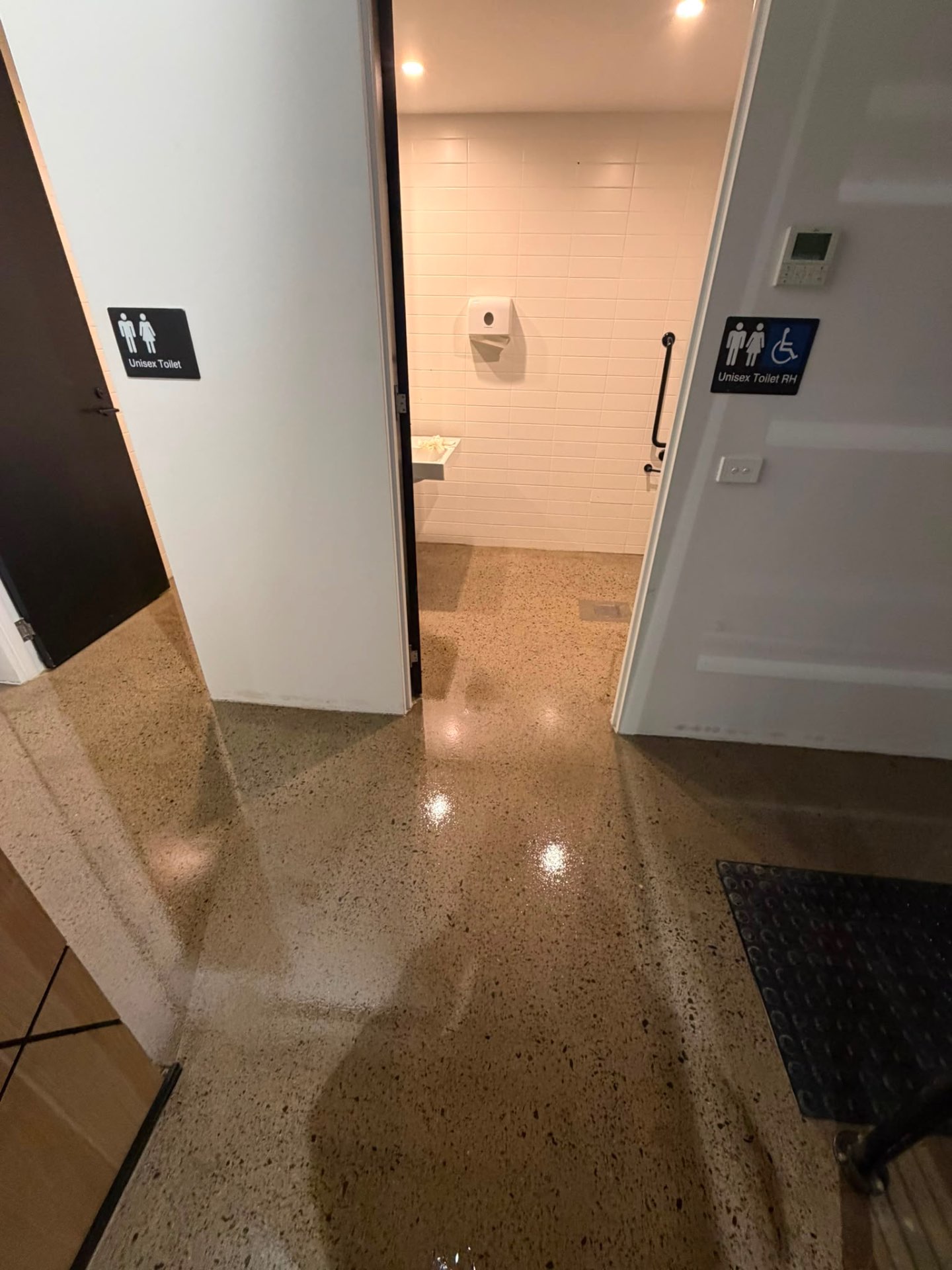
Wear in a distribution centre is highly concentrated. The majority of damage we assess sits in a small fraction of the total floor area: dock plate approaches, the first ten metres inside overhead doors where road salt and grit are tracked in, turning circles at aisle ends, and pick faces where equipment starts and stops hundreds of times per shift.
Wheel type matters more than most buyers expect. Hard polyurethane and steel wheels concentrate load into a very small contact patch and will find any weakness in the surface or the joint edge. Cushion tyres are gentler but drag grit. Where a facility mixes electric reach trucks with propane counterbalance units, the floor sees both abrasion and thermal and chemical exposure in the same aisle.
Designing to that reality means putting a heavier, mortar-based build where the punishment lands and an economical densified seal under static racking where nothing but a pallet ever touches concrete. Coating an entire building to one specification either overspends on the quiet seventy per cent or underspecifies the busy thirty and brings you back within three years.
- Reinforced dock plate and overhead door transitions
- Heavier build in turning circles and pick faces
- Semi-rigid polyurea joint filling to support wheel loads
- Economical densify-and-seal beneath static racking
Dust control, chemical resistance and housekeeping
Concrete dusting is the complaint we hear most often from warehouse operators, and it is entirely solvable. The surface paste on an untreated or worn slab breaks down under traffic and releases fine particulate continuously. It settles on packaging, works into conveyor bearings and equipment filters, and shows up in air-quality discussions long before anyone connects it to the floor.
Chemical exposure in warehousing is usually narrower than in manufacturing but concentrated in known places: hydraulic fluid and battery acid around charging stations, diesel and road salt at the docks, and whatever your stored product leaks when a pallet is dropped. A coating keeps those contaminants on the surface where a scrubber can lift them instead of letting them soak into the slab, where they become permanent staining and, in the case of chlorides, a long-term corrosion risk to reinforcement.
The practical outcome is lower housekeeping cost. Auto-scrubbers work as designed on a sealed, non-porous surface, cleaning cycles shorten, and the floor stops fighting your maintenance team.
Surface preparation is the whole job
Every warehouse floor failure we are asked to diagnose traces back to preparation. A coating cannot bond to laitance, curing compound, old sealer, oil-saturated concrete or a power-trowelled surface that was never opened up. The resin is the least interesting part of the specification.
Our preparation sequence is consistent: shot blast or diamond grind the slab to a measured concrete surface profile, degrease and treat oil-saturated zones, rebuild spalls and pits with a fast-set repair mortar, chase and fill cracks, then fill control joints. Moisture is tested before anything is applied, because a slab without a vapour barrier — common in older GTA industrial stock — will push a non-breathable coating off within a year unless a moisture-tolerant primer is specified.
That work is unglamorous and it is where the budget should go. A mid-range system over correct preparation will always outlive a premium system over a shortcut. Concrete grinding and surface preparation is a service we sell on its own precisely because it carries the outcome.
Choosing a warehouse flooring system
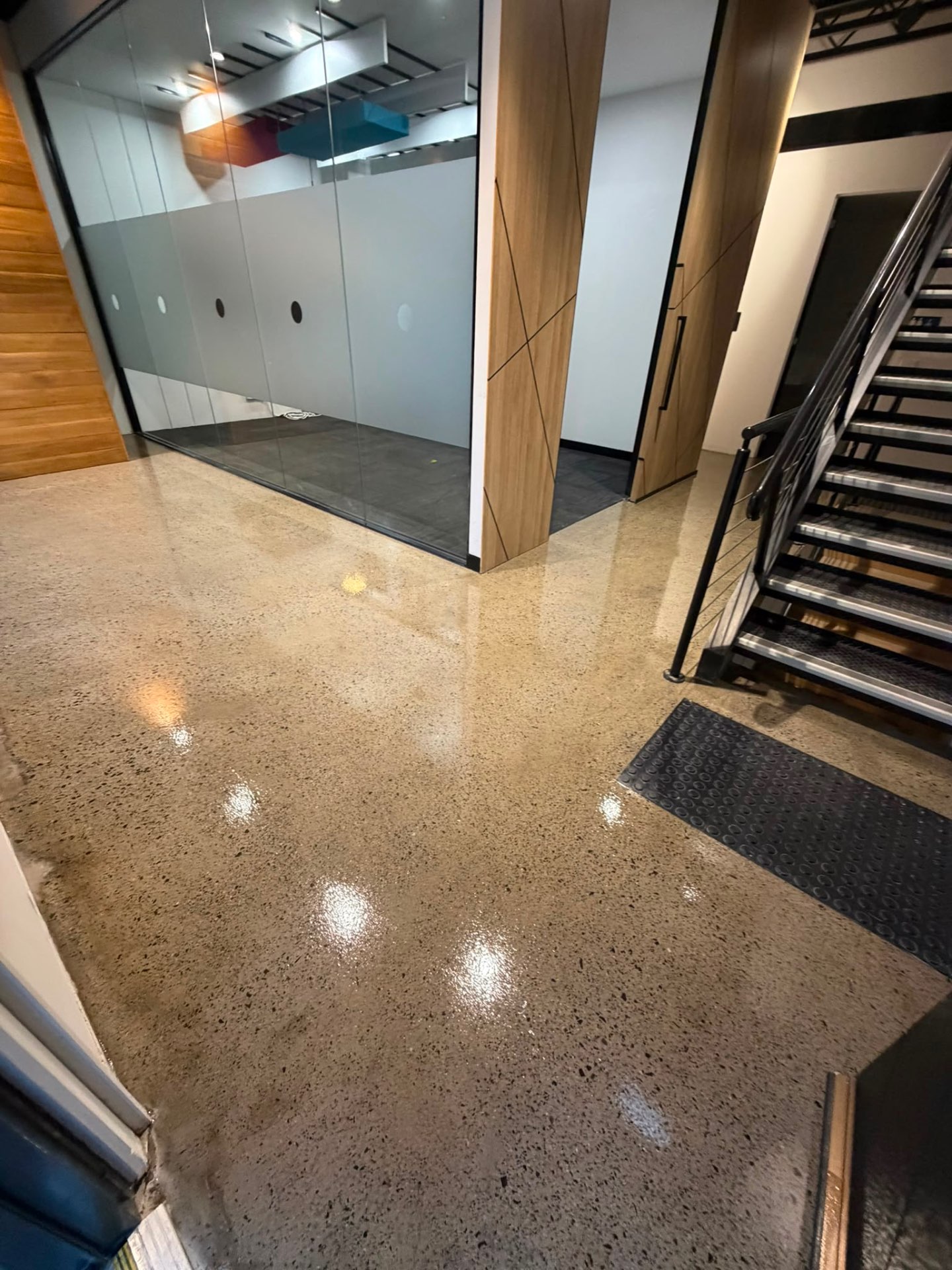
Four families of system cover nearly every warehouse requirement in the GTA. Each has a genuine place and each has a limitation worth knowing before you sign anything.
Densify and seal
Lithium silicate densifier plus a penetrating sealer. Lowest cost per square foot, keeps the raw concrete look, stops dusting and cannot peel because there is no film. Limitation: modest stain and chemical resistance, and it will not hide existing discolouration.
Roll-applied epoxy
100% solids epoxy in a solid colour, typically 12 to 20 mils. Strong value in mid-traffic zones, easy to clean and holds line striping crisply. Limitation: rigid, so joints must be detailed properly, and it ambers under strong daylight unless topcoated.
Polyaspartic and hybrid systems
Fast-cure topcoats with excellent abrasion and UV resistance that return a zone to service in hours. Limitation: higher material cost and a short working window, so they need an experienced crew — but often the only viable route in a facility that cannot pause.
Urethane cement
The heavyweight option for wash-down bays, thermal shock and food-grade storage. Extremely tough and tolerant of residual slab moisture. Limitation: textured rather than glossy and priced accordingly, so we reserve it for zones that genuinely require it.
Phased installation around a live operation
The question every operations manager asks first is how much of the building we need and for how long. The honest answer is that it depends on how much you are willing to move, and we plan around your answer rather than dictating one.
A typical phased programme runs zone by zone over consecutive weekends or night blocks. We agree the sequence with your operations lead so racking is emptied once per zone, protect adjacent areas with containment, and hand each zone back to traffic on a committed time. Dust extraction runs on every grinder, and low-odour systems are specified where product or staff occupy adjacent space.
Where the building genuinely can be emptied — a fit-out before tenancy, a seasonal shutdown, a facility relocation — a continuous programme is faster and cheaper per square foot, and we will always tell you when that is the case.
- Zone-by-zone or weekend block scheduling
- Committed hand-back times per zone
- Dust extraction and containment on all preparation
- Low-odour systems where operations continue nearby
Maintaining a warehouse floor over its service life
A coated warehouse floor is far easier to maintain than bare concrete but it is not maintenance-free. Auto-scrub on a regular cycle with a neutral-pH cleaner; high-alkaline and citrus degreasers progressively dull a topcoat and shorten its life. Fit entry matting at door thresholds, because tracked-in sand and salt act as sandpaper under forklift wheels.
Inspect the wear lanes annually. A thinning topcoat usually shows as a change in sheen well before any substrate appears — at that point a scuff-sand and recoat of that zone restores the system for a small fraction of the original cost. Left until concrete is exposed, the same area becomes a rebuild.
We hand over a written system record at completion listing every product, film thickness and recommended cleaning chemistry, so your facilities team and any future contractor know exactly what is on the floor. Our workmanship carries a 10-year warranty where the maintenance schedule is followed.
Warehouse flooring at a glance
- Who it is for
- Warehouse owners, distribution centres, 3PL and logistics operators, operations and facility managers
- Core problems solved
- Concrete dusting, forklift and joint damage, spill absorption, poor visibility, unmarked traffic routes
- System options
- Densify and seal, roll-applied epoxy, polyaspartic hybrid, urethane cement in wash-down zones
- Preparation
- Shot blast or diamond grind, degrease, spall and crack repair, semi-rigid polyurea joint fill, moisture testing
- Return to service
- 12–24 hours with fast-cure systems; 48–72 hours with standard epoxy
- Typical service life
- 8–15 years with topcoat renewal in wear lanes
- Service area
- Toronto, Mississauga, Brampton, Vaughan, Markham, Scarborough and the wider GTA
Warehouse Flooring FAQs — Toronto & GTA
Explore related flooring systems and service areas
Warehouse Floor Coatings
The coating service itself — systems, build thicknesses and striping.
Industrial Epoxy Flooring
Heavy-duty systems for processing and production environments.
Commercial Epoxy Flooring
Our core commercial epoxy service across the GTA.
Concrete Grinding & Sealing
Surface preparation and the low-cost dust-control route for storage areas.
Epoxy Flooring in Brampton
Serving the Bramalea and Highway 407 logistics corridor.
Epoxy Flooring in Mississauga
Distribution and airport-corridor facilities near Pearson.
Book a free warehouse floor assessment
Tell us your square footage, equipment types and operating hours. We will walk the slab, map the wear zones and joints, and return a phased proposal that keeps your building running.
Call: (647) 970-8226
Email: Buildwellflooringsolutions@gmail.com
Shop: 7030 Woodbine Ave, Markham, ON L3R 6G2
Free estimates · 10-year workmanship warranty · Fully insured
Prefer email? Use our contact page.
Serving Toronto & the GTA · Free estimates · 10-year workmanship warranty
Get a Free Estimate