
Solid Colour Epoxy Flooring for GTA Industrial, Commercial and Garage Floors
A single-colour epoxy floor is the most cost-effective way to seal, protect and brighten a concrete slab. Buildwell installs solid colour systems across Toronto and the GTA, built to the thickness the traffic actually requires.
- Lowest cost per square foot of our coated systems
- Smooth, uniform surface that is simple to clean
- Standard and custom brand-matched colours
- Holds safety line striping crisply
- Build thickness scaled from light commercial to forklift traffic
- Light-reflective finish that brightens dim facilities
What a solid colour epoxy system is
Solid colour epoxy is the foundational resinous floor: a penetrating primer, one or more opaque pigmented 100% solids epoxy build coats, and a clear or pigmented topcoat that determines gloss, chemical resistance and slip profile. There is no decorative broadcast, which is exactly the point — the finish is uniform, smooth and easy to read.
That uniformity is functional. In a food-prep area or a laboratory, a smooth floor with no texture is the easiest surface to sanitize. In a warehouse, an unbroken colour makes spilled product and dropped hardware immediately visible. In a service bay, a light colour reflects overhead light down onto the work.
The system is often described as the budget option, which undersells it. At equal film thickness a solid colour protects the concrete just as well as a decorative build; what you give up is the ability to hide dirt, not durability.
Where solid colour epoxy works best
The system suits any space where cleanliness, visibility and cost efficiency outrank decorative appearance. Across the GTA, these are the applications we install most often.
Industrial and manufacturing
Production floors, plant rooms, equipment areas and mechanical spaces. Built as a mortar system where forklifts run, the same pigmented finish covers everything from light assembly to heavy plant.
Warehouses and storage
Large open areas where a single colour brightens the building and makes striping legible. Frequently combined with heavier builds at dock plates and turning circles.
Commercial back-of-house
Kitchens, prep rooms, stock rooms, mechanical and janitorial spaces where a smooth, sanitizable surface matters more than appearance.
Residential and shop garages
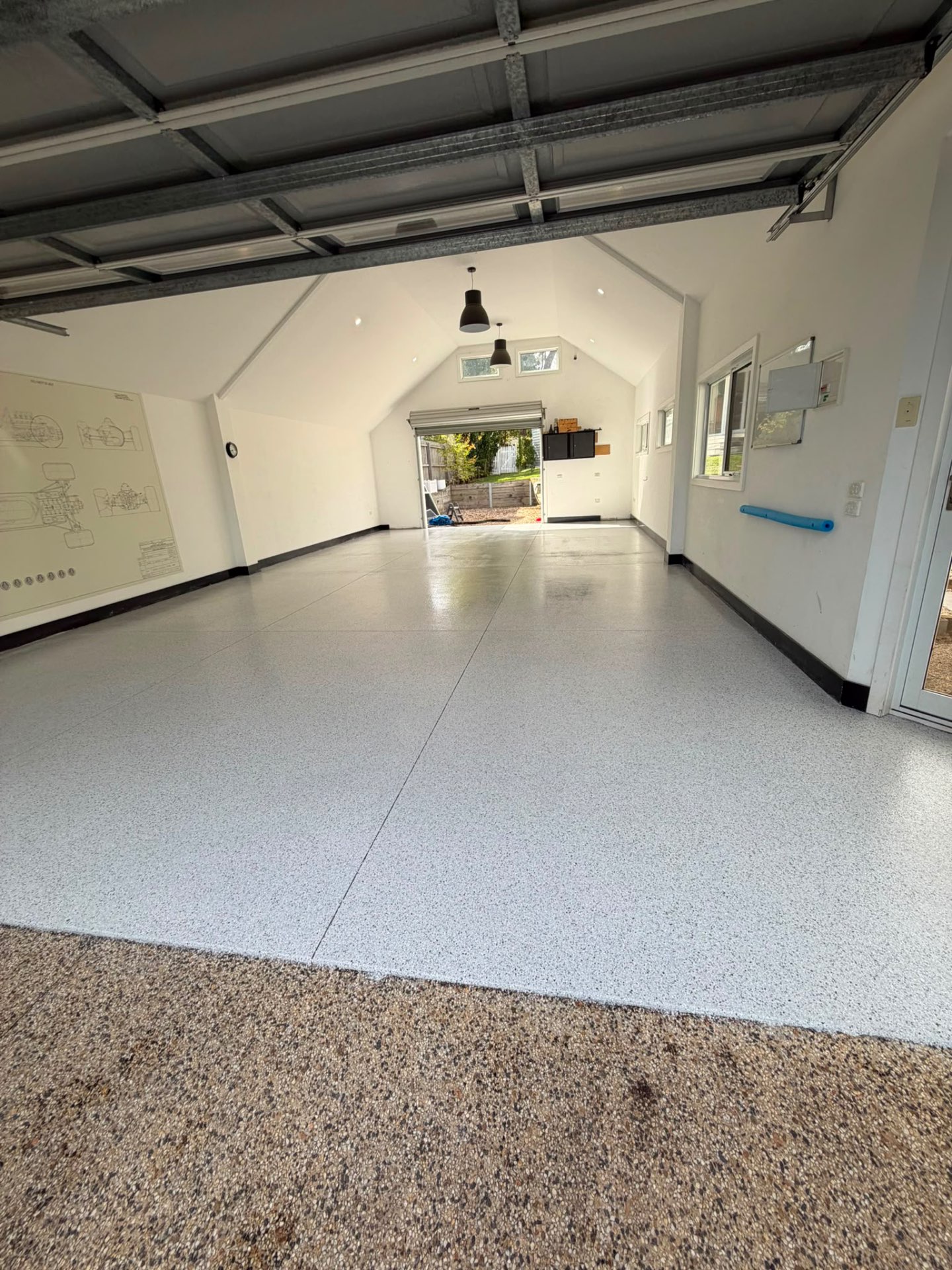
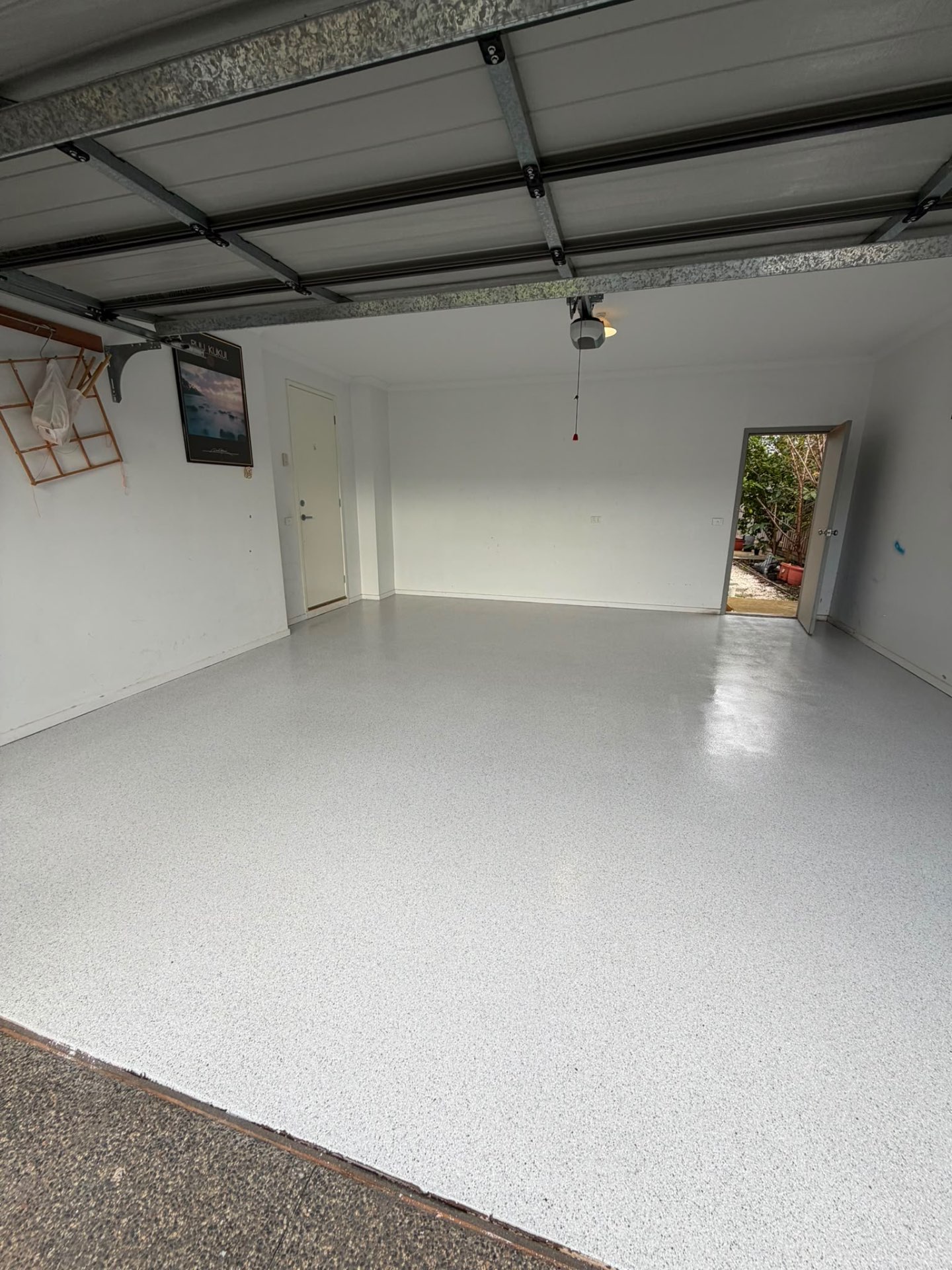
The straightforward, economical garage floor. Seals the slab against road salt and oil, brightens the space, and costs less than a flake system — at the price of showing tyre marks more readily.
Colour selection, striping and wayfinding
Standard palettes cover the greys, beiges, tile reds, safety yellows, blues and greens that most facilities use, and pigment can be custom-matched to a brand colour where the floor is visible to customers. Light greys and beiges are the most common industrial choice because they raise perceived brightness considerably in buildings with limited fixtures.
Colour choice has practical consequences worth weighing. Very dark floors look sharp but show dust and footprints. Very light floors show tyre marks and dropped-tool scuffs. Mid-tone greys are the pragmatic middle ground and are what most facility managers settle on once they have seen both extremes in service.
Because the base is uniform, solid colour holds line striping better than any other system we install. Pigmented striping is applied over the base coat and sealed under the clear topcoat, so aisle markings, pedestrian walkways, hazard zones and equipment footprints become part of the floor rather than tape that lifts in a month.
- Standard and custom brand-matched pigments
- Encapsulated line striping that cannot be scrubbed off
- Colour-coded zoning for safety and wayfinding
- Light-reflective tones to brighten low-lit facilities
Durability and building to the right thickness
The most common mistake with solid colour epoxy is treating it as one product. It is a family of build-ups, and the difference between a floor that lasts fifteen years and one that fails in two is thickness matched to traffic, not brand of resin.
For office back-of-house, stock rooms and light commercial areas, a roll-applied system at 12–20 mils is appropriate and economical. For moderate industrial traffic, pallet jacks and rubber-tyred equipment, we increase the build and step up the topcoat. For forklifts, steel wheels, dropped tooling and dock impact, only a troweled epoxy mortar at 1/8" or heavier will survive, regardless of what the finish looks like.
Chemical exposure is specified separately. Standard epoxy handles oils, fuels, coolants and dilute acids well; concentrated acids, solvents or hot wash-down move us to a novolac topcoat or urethane cement. We would rather ask what actually hits your floor than sell one specification to every building.
Preparation and installation
Because the finished surface is uniform and unbroken, preparation defects show. Patch outlines, grinder swirl marks and high spots are all visible under a single colour in a way they are not under a chip blend, so our preparation standard is if anything higher for solid colour work.
We test for moisture vapour transmission, diamond-grind or shot-blast the slab to an ICRI CSP 3–5 profile, chase and fill cracks with polyurea, rebuild spalls and pits with repair mortar, and level low spots. Control joints are honoured rather than bridged. The slab is then vacuumed and primed before any pigmented material goes down.
A typical commercial installation runs three to four days including cure, or 24–36 hours where a fast-cure polyaspartic system is specified for a facility that cannot stop. Night shifts, weekends and phased zone work are standard for us on occupied buildings.
Limitations to weigh before choosing solid colour
The trade-off is visual forgiveness. A uniform colour shows tyre marks, dust, footprints, minor stains and every scratch far more than a flake or metallic finish. In a busy garage or a workshop, that means the floor looks like it needs cleaning more often, even when it is perfectly sound.
A plain gloss finish is also slick when wet, so slip additives should be specified deliberately for any area that sees water, slush or wash-down. Standard epoxy ambers under UV, so sun-exposed areas need an aliphatic topcoat. And like all rigid resin systems, it will telegraph an actively moving crack — crack treatment happens during preparation, not after.
If the floor will be highly visible and heavily used, flake epoxy is usually the better long-term satisfaction choice even though it costs more. If cleanliness, visibility and budget lead the decision, solid colour is the right answer and we will say so.
Maintenance and recoating
Maintenance is simple but should be consistent. Dust-mop or auto-scrub on a regular cycle with a neutral-pH cleaner. Clean spills promptly, since a uniform surface shows staining more readily. Avoid citrus-based and high-alkaline degreasers, which progressively dull the topcoat, and keep grit controlled at entry points with matting.
Rubber-wheel scuffs are cosmetic and lift with a melamine pad or a mild solvent wipe. Where equipment routinely pivots in the same spot, expect the topcoat to thin there first — that is by design, because the topcoat is the sacrificial layer.
When traffic lanes lose sheen, abrade and recoat those zones rather than replacing the floor. Done at the right time, this returns the system to as-new condition for a small fraction of the original cost. We provide a written system record at handover so the recoat can be matched exactly, and our workmanship is backed by a 10-year warranty where the specified maintenance is followed.
Solid colour epoxy flooring at a glance
- What it is
- Primer, opaque pigmented 100% solids epoxy build coats, and a clear or pigmented topcoat
- Best suited to
- Industrial floors, warehouses, commercial back-of-house, kitchens, service bays, garages
- Typical thickness
- 12–20 mils roll-applied; 1/8" or heavier troweled mortar for forklift traffic
- Colour options
- Standard industrial palette plus custom brand-matched pigments
- Key advantages
- Lowest coated-system cost, easy to sanitize, brightens facilities, holds line striping
- Key limitations
- Shows tyre marks and dust; slick when wet without additive; ambers under UV unless topcoated
- Install time
- 3–4 days standard; 24–36 hours with fast-cure systems
Solid Colour Epoxy Flooring FAQs — Toronto & GTA
Explore related flooring systems and service areas
Warehouse Flooring Solutions
Solid colour and striping in distribution facilities.
Industrial Epoxy Flooring
Heavy-duty mortar builds for plants and processing facilities.
Warehouse Floor Coatings
Dust control, striping and slab restoration for logistics sites.
Flake Epoxy Flooring
The decorative upgrade that hides dirt and tyre marks.
Garage Epoxy Floors
Full garage service including diagnosis and warranty.
Concrete Grinding & Sealing
The lower-cost, film-free option when appearance is not a factor.
Epoxy Flooring in Markham
Serving Markham from our Woodbine Avenue shop.
Get a solid colour epoxy specification and price
Tell us the space, the traffic and any chemical exposure. We will attend site, test the slab and quote the build thickness the floor actually needs — not a one-size specification.
Call: (647) 970-8226
Email: Buildwellflooringsolutions@gmail.com
Shop: 7030 Woodbine Ave, Markham, ON L3R 6G2
Free estimates · 10-year workmanship warranty · Fully insured
Prefer email? Use our contact page.
Serving Toronto & the GTA · Free estimates · 10-year workmanship warranty
Get a Free Estimate